
|
Getting your Trinity Audio player ready...
|
- AI brings speed, efficiency, and accuracy for basic language checks
- Human editors contribute domain expertise, understanding of nuanced journal requirements, and ability to assess flow and coherence across a paper as a whole.
- AI is best used as a first pass, with an AI editing tool correcting grammatical errors as you type.
- Human editing is best reserved for the final version of the paper, to make it submission-ready.
Contents
- Advantages of AI editing
- Disadvantages of AI editing
- Advantages of human professional editing
- Disadvantages of human professional editing
- The right way to combine AI and human editing
Advantages of AI editing
On the go
AI-powered writing assistants like Paperpal can fix your writing as you type. Authors, especially those for whom English is a second language, save time worrying about article usage and subject verb agreement and can concentrate on describing their research instead.
Cheaper
General-purpose chatbots like ChatGPT have a generous free tier, as do purpose-built academic writing tools like Paperpal. Authors who write in MS Word often can avail of Copilot right where they are writing, without needing to install an extension or switch to a browser.
Accurate for basic language checks
AI excels at baseline language polishing: grammar, punctuation, and spelling. AI tools can also fix awkward constructions and make your writing sound polished and fluent.
Highly consistent across lengthy documents
AI doesn’t tire or fatigue across an 80,000-word thesis the way a human would. It makes edits consistently and doesn’t require caffeine. This is particularly useful if you have a large, inconsistent document and want a coherent style across multiple chapters. You can prompt AI to follow a specific style guide or set of rules, and it’ll do consistently on page 99 as well as page 1.
Disadvantages of AI editing
Risk of hallucinations
Hallucinations occur when AI produces plausible but fake output, such as a fabricated citation or statistic. Hallucinations are difficult to spot because 1) AI is trained to sound fluent and confident and 2) hallucinations are outwardly “perfect”, e.g., the fake citation is perfectly formatted in APA style and even includes a real journal name, but the article just doesn’t exist.
Introduction of non-standard terminology or phrasing
General-purpose free chatbots, in particular, which have been trained on a huge corpus of all kinds of text, can use terms and phrasing that aren’t standard in your field. For example, they could describe a software or equipment in promotional terms (e.g., the GeneXpert Mtuberculosis/RIF assay is a phenomenal advance in tuberculosis detection, with a simple, closed cartridge system that brings WHO-endorsed molecular accuracy to virtually any clinic, so that patients get the right treatment faster). A research paper should describe the same assay as something like “Specimens were tested using the Xpert MTB/RIF assay (Cepheid, Sunnyvale, CA, USA) on the GeneXpert platform according to the manufacturer’s instructions. This cartridge-based, automated real-time PCR assay detects Mycobacterium tuberculosis complex DNA and mutations in the rifampicin resistance-determining region of the rpoB gene. Sample processing, nucleic acid amplification, and detection occur within a closed, single-use cartridge.”
Data security
Many free AI tools retain your inputs and use them for training their models. This makes the tools unsuitable for any confidential data, especially protected health information from patients, study data that could be related to a patent, or another author’s research paper. This in fact is why many journals and publishers forbid peer reviewers from uploading a manuscript they’re reviewing into a public AI tool.
Advantages of human professional editing
Substantive editing for logic and flow
Many AI tools process a manuscript well at the sentence level but can’t evaluate it logically as a whole. So while grammar and phrasing errors are corrected, there may be logical gaps between sections (e.g., the research question in the Introduction doesn’t match the choice of methods or the Discussion highlights a research gap that the results don’t actually fill).
No hallucinations
A human editor focuses on the text that’s actually there, and simply leaves a comment asking the author to supply any crucial information that’s missing. An AI tool may “helpfully” supply that missing information, sometimes through a web search that may or may not be correct.
Higher data security
Professional editing services completely understand the need for data security in research environments. Editage, for example, has ISO/IEC 27001:2013 compliant information security processes, and all employees sign rigorous and binding confidentiality agreements.
Adherence to journal requirements
While AI tools excel at some mechanical formatting tasks like citations and references, they may not grasp the overall expectations and requirements of a journal. For example, the journal Blood does publish single-case reports but only those on highly novel and important topics. A human editor who sees that an author is planning to submit a case report to Blood will make sure that the novelty and importance of that case is clearly highlighted in the manuscript and cover letter, and inform the author if there’s insufficient detail about these two aspects.
Disadvantages of human professional editing
Slower
In a race between humans and machines, machines always win. AI can process a 10,000-word manuscript in less than an hour while a human editor would require at least 3 days to do it justice, especially if the author wants substantive editing.
More expensive
ChatGPT, Claude, etc. have free versions. An editing service employs skilled professionals who need to be paid for their work. Editing costs range from USD 0.042 to USD 0.110 per word, depending on the level of editing you ask for.
Less consistent across lengthy documents
If you’re on a tight deadline, an editing service may split up your sections or chapters across multiple editors in order to accommodate you. This can lead to minor inconsistencies across the full text.
The right way to combine AI and human editing
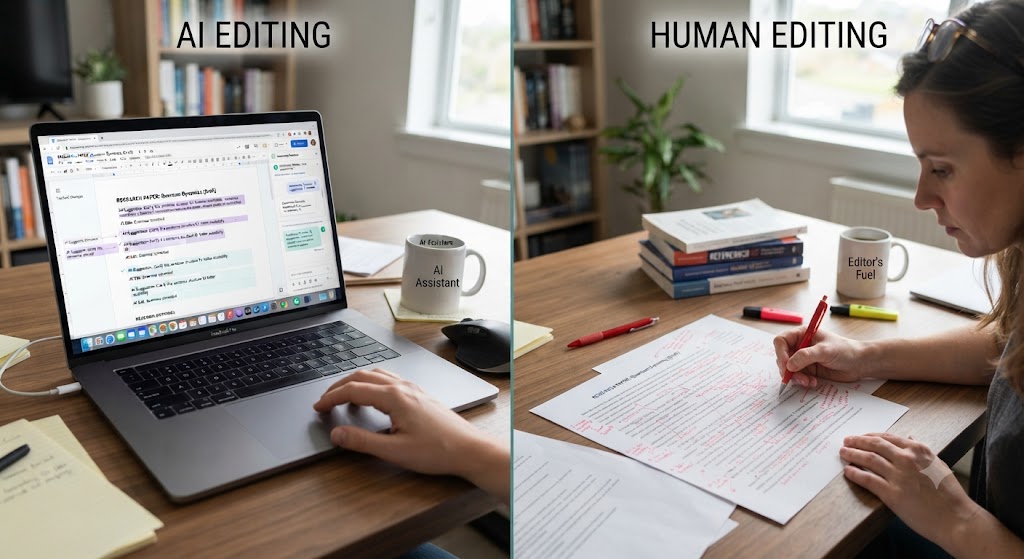
The best option to combine AI’s speed and accuracy with a human editor’s depth and subject-matter knowledge is to use AI for a first pass, fixing grammatical errors as you write. Then, once your manuscript is in the right shape, you’ve locked down all your data, and have verified that no AI edits have introduced hallucinations or factual distortions, that’s the time for a final pass by a human expert editor. At this stage, your editor will look at basic grammar and punctuation but also critically revise your manuscript for flow, logic, coherence, adherence to journal guidelines, and general writing conventions in your field.
Practical Example: AI vs Human Editing
Here’s a paragraph from the Discussion section of a paper in nutrition science:
In the present study, we observed that higher consumption of dietary fiber was associated with lower levels of fasting blood glucose among the participants. This result is in agreement with previous studies which also have shown the beneficial effect of fiber on the glycemic control. However, the mechanism is still not fully clear. It is possible that soluble fiber delays the gastric emptying and therefore the absorption of glucose become slower. Also, the fermentation of the fiber in colon produce short-chain fatty acids, and these may improve insulin sensitivity. On the other hand, our participants were mostly young adults, so it is difficult to generalize the findings. In addition, the dietary intake was measured by food frequency questionnaire, which have some limitations like recall bias. Moreover, the fruit and vegetables intake was also high in this group so the effect may be party due to polyphenols in these foods. Therefore, future studies with more larger and diverse population are needed to confirm these results and to clarify the role of fiber.
AI-Edited Version
In the present study, we observed that higher consumption of dietary fiber was associated with lower fasting blood glucose levels among the participants. This result is in agreement with previous studies, which have also shown the beneficial effect of fiber on glycemic control. However, the mechanism is still not fully clear. It is possible that soluble fiber delays gastric emptying, and therefore glucose absorption becomes slower. Also, the fermentation of fiber in the colon produces short-chain fatty acids, which may improve insulin sensitivity. On the other hand, our participants were mostly young adults, so it is difficult to generalize the findings. In addition, dietary intake was measured using a food frequency questionnaire, which has some limitations, such as recall bias. Moreover, fruit and vegetable intake was also high in this group so the observed association may be partly due to the effect of polyphenols rather than fiber alone. Therefore, future studies with larger and more diverse populations are needed to confirm these results and to clarify the role of fiber.
Human-Edited Version
In the present study, higher dietary fiber consumption was associated with lower fasting blood glucose levels among participants. This finding is consistent with previous studies that have also reported a beneficial effect of fiber on glycemic control. Although the underlying mechanism is not yet fully understood, several explanations are plausible. Soluble fiber may delay gastric emptying, thereby slowing glucose absorption. In addition, the fermentation of fiber in the colon produces short-chain fatty acids, which may improve insulin sensitivity.
Nevertheless, several limitations should be considered when interpreting these results. First, our participants were mostly young adults, which limits the generalizability of the findings. Second, dietary intake was assessed using a food frequency questionnaire, which is subject to limitations such as recall bias. Third, fruit and vegetable intake was also high in this group, so the observed association may be partly due to the effect of polyphenols rather than fiber alone. Therefore, future studies with larger and more diverse populations are needed to confirm these results and to clarify the specific role of fiber.
What AI did well
- Correct every grammatical error
- Fix a typo “party” that a human might overlook as it’s a real word that doesn’t show up in a spell check.
- Remove non-native phrasing like “the fermentation of the fiber in colon”.
What a human added to AI editing
- Sentences rearranged for flow: the relationship between dietary fiber and blood glucose, followed by potential explanatory mechanisms.
- Paragraph split up as the limitations can logically form their own, standalone paragraph
- Ordinal numbers (first, second, third) used as transitional markers for limitations, for easier reading.