


|
Getting your Trinity Audio player ready...
|
TL;DR:
- Predatory journals collect author fees but skip the services they advertise: real peer review, copyediting, indexing, and long-term archiving.
- The 4 strongest warning signs are flattering unsolicited invitations, unverifiable indexing claims, no transparent fee disclosure, and an editorial board you cannot confirm.
- Verify every claim at the source. Search Scopus, Web of Science, DOAJ, and PubMed directly instead of trusting the logos printed on a journal’s homepage. Use Think.Check.Submit if you’re new to academic publishing.
- Budget 20-30 minutes for screening before you submit, because once a predatory journal publishes your paper, most legitimate journals will refuse it as prior publication.
Contents
- What Is a Predatory Journal?
- Why Does Publishing in a Predatory Journal Hurt Your Career?
- Signs of a Predatory Journal: The Invitation Email
- Checking the Editorial Board
- How Do You Check if a Journal Is Indexed in Scopus or Web of Science?
- What Do Legitimate Journal Metrics Look Like?
- Fees, Invoices, and Payment Requests
- A 10-Point Screening Checklist
- Journals in the Gray Zone
- What to Do If You Have Already Submitted to a Predatory Journal
- Frequently Asked Questions
Do you have an email address? If yes, you’ve definitely received obsequious invitations praising a paper you wrote 3 years ago, promising review in 72 hours and publication within 2 weeks. A miniscule minority come from real journals. Most come from operations that exist to convert your submission into an invoice.
The good news is that predatory publishing leaves fingerprints. This guide sets out the checks that separate a legitimate outlet from a fee-collecting imitation, in the order you should perform them.
What Is a Predatory Journal?
A predatory journal is a publication that charges author fees but does not deliver the editorial services it promises: no genuine peer review, no copyediting, and no indexing in a reputed database. The business model is volume, not scholarship.
The term covers a spectrum. At one end sit outright fakes that clone the name and design of an established title. At the other sit low-quality journals that perform a token review and publish nearly everything received. But only the first is fraudulent in a legal sense.
The differences show up clearly against the functions a journal is supposed to perform.
| Journal function | Legitimate publisher | Predatory publisher |
| Peer review | 2-3 external reviewers, 4-12 weeks, substantive reports | Review in 24-72 hours or a template acceptance letter |
| Editorial decisions | Rejection rates typically 40-90 percent | Near universal acceptance, including nonsense submissions |
| Fee disclosure | Charges published openly before submission | Invoice appears only after your paper is accepted |
| Indexing | Indexed with DOAJ, SCI, SCIE, SSCI, Scopus, PubMed/MEDLINE, and subject-specific databases | Content lives only on the publisher’s own server |
| Corrections | Formal retraction and correction policy | No policy, or content quietly disappears |
Why Does Publishing in a Predatory Journal Hurt Your Career?
Because the article is rarely indexed, rarely cited, and cannot be moved. Most legitimate journals treat it as already published, so the work is effectively locked away in a venue nobody searches. If another researcher ever finds your article, they will assume it’s poor quality and not bother to read or cite it.
The consequences accumulate quietly:
- Hiring, tenure, and promotion committees increasingly screen publication lists against Scopus and Web of Science. Publishing in a predatory journal makes you look naïve and suggests that the research itself was low-quality.
- Funders in several countries, including major national agencies, refuse to count such outputs toward grant reporting requirements.
- Systematic reviewers exclude the article, so the research never enters the evidence base it was written for.
- The paper cannot be withdrawn and resubmitted, because doing so risks a duplicate publication finding against you.
- For graduate students, publication in such journals is not counted toward your thesis and does not help you secure a postdoc or tenure-track position.
Signs of a Predatory Journal: The Invitation Email
Solicitation emails are the most common first contact, and they are also the easiest to evaluate. Compare the language against what a real editorial office sends.
| Signal | Legitimate journal | Predatory journal |
| Salutation | Uses your name and cites a specific paper accurately | Generic greeting, or praise for a paper outside your field |
| Scope | Matches the journal’s stated subject area | Claims to cover very broad subjects like medicine, engineering, and humanities at once |
| Timeline | No promise of an acceptance date | Guarantees publication in 7-14 days |
| Sender address | Institutional or publisher domain | Free webmail address such as gmail.com or 163.com |
| Tone | Neutral and procedural | Flattery, urgency, and discount codes that expire |
A single item on this list is not proof. Small society journals sometimes use modest infrastructure. Three or more items together are conclusive enough to stop reading.
Red Flags on the Journal Website
Look for specific failures rather than a general impression of quality. Predatory sites are often visually polished; the gaps are in the details.
- No verifiable street address, only a contact form or a mail drop in a country unrelated to the stated editorial office.
- An ISSN that does not resolve on the ISSN Portal, or a single ISSN reused across several titles.
- Missing or copied policies on peer review, ethics, plagiarism screening, and conflicts of interest.
- Broken DOIs, or article pages that display no DOI at all.
- Spelling and grammar errors in published articles, which signal that no copyediting occurred.
- Stock photographs used for editors, or editor photographs that appear elsewhere under different names.
- Very prominent displays of indexing and impact factor
Download 2 or 3 published PDFs and read them. Would you ever cite them in your own paper? Would you share them with your supervisor or colleagues? Nothing reveals an absent review process faster than the articles the journal was willing to print.
Checking the Editorial Board
Predatory publishers routinely list respected academics who never agreed to serve, and some list people who died years earlier. The board is therefore one of the fastest checks available.
Pick 3 names at random and verify each one:
- Search the person’s institutional profile page and LinkedIn account. A genuine board member usually lists the role there.
- Confirm that the named institution and department still exist and still employ that person.
- Check whether the editor has published in the journal’s own subject area within the last 5 years.
- Email 1 board member directly and ask whether they review for the title. Silence is informative; a denial is decisive.
- Look for a listed editor-in-chief or a stock/AI-generated image used for the editor-in-chief’s photo. Journals that name no single responsible editor are a serious concern.
How Do You Check if a Journal Is Indexed in Scopus or Web of Science?
Search the database’s own master list: Scopus Sources for Scopus and the Clarivate Master Journal List for Web of Science. Never accept a logo or screenshot displayed on the journal’s website as evidence.
Indexing claims are the single most falsified item in predatory publishing, partly because the logos are easy to copy and partly because authors rarely verify them. Use the tools below, all of which are free.
| Tool | What it verifies | Notes |
| Scopus Sources (Elsevier) | Current Scopus coverage and discontinued titles | Check the discontinued list too, since coverage can be revoked |
| Master Journal List (Clarivate) | Web of Science coverage and Impact Factor eligibility | Only titles in the Core Collection receive an Impact Factor |
| DOAJ | Open access journals meeting transparency criteria | Removal from DOAJ is itself a warning sign |
| NLM Catalog and PubMed | MEDLINE and PubMed Central indexing | Being in PubMed Central is not identical to MEDLINE indexing |
| ISSN Portal | Whether the ISSN is registered to that exact title | Mismatched titles indicate cloning |
| Think.Check.Submit | A structured checklist for unfamiliar titles | Useful when the other checks are inconclusive |
What Do Legitimate Journal Metrics Look Like?
Only 2 journal metrics come from the same entities that run audited databases: the Journal Impact Factor from Clarivate and CiteScore from Scopus. Another reputable metric is SCImago Journal Rank (SJR), which is also based on Scopus data. Anything else advertised as an official impact score deserves immediate suspicion.
Fabricated metrics are sold by companies that will assign a number to any journal for a fee. Watch for invented names such as Global Impact Factor, Universal Impact Factor, and Cosmos Impact Factor.
- A journal quoting an Impact Factor to 3 decimal places while absent from the Master Journal List is misrepresenting itself.
- A newly launched journal cannot have an Impact Factor, because eligibility requires roughly 2-3 years of indexed content.
Fees, Invoices, and Payment Requests
Article processing charges are normal in open access publishing. What matters is when the charge is disclosed, how it is calculated, and where the money is sent.
| Practice | What it usually means |
| Fee schedule published on the journal website with transparent pricing and details of waivers | Standard practice at reputable open access publishers |
| Fee revealed only in the acceptance letter | A strong predatory indicator, since your paper is now hostage |
| Payment to a personal bank account or wallet | Almost always fraudulent |
| Submission fee plus a separate publication fee plus a withdrawal fee | Layered charges designed to extract more after commitment |
| Aggressive discounts tied to a deadline | Sales pressure, not editorial practice |
Ask for the fee schedule in writing before you submit anything. A journal that cannot answer that question in 1 short email is telling you what you need to know.
Example
Take a look at the fee pages of the website of PLOS, a legitimate open access publisher.
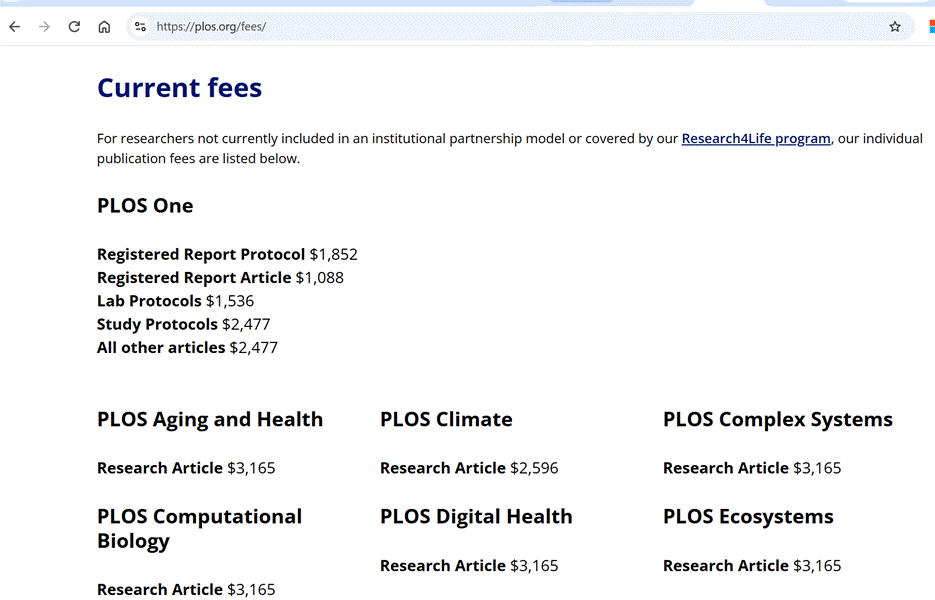
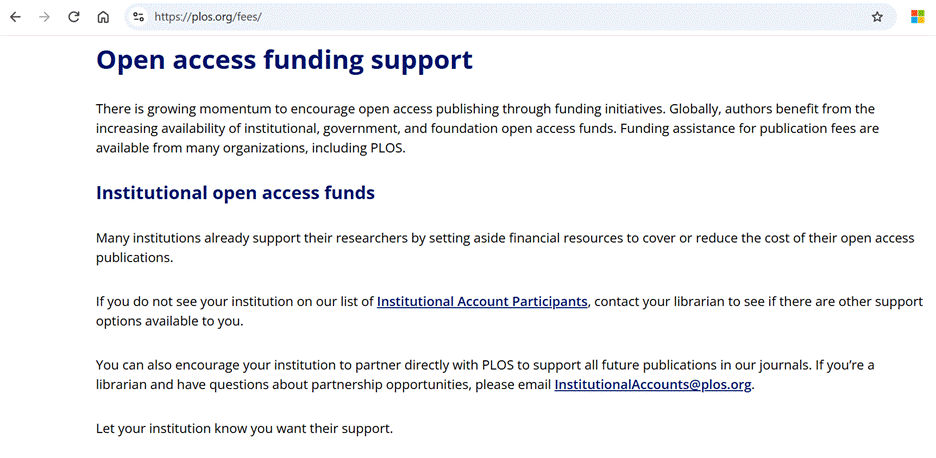
Note the following:
- Fees are disclosed transparently
- Waivers through institutional partners and the Research4Life program are stated upfront
- Contact information for fee queries is a legitimate organizational email address
- PLOS transparently invites university librarians and research funding agencies to a dialog about publication charges.
These signs together indicate that PLOS is a legitimate journal publisher.
A 10-Point Screening Checklist
Run this list before every submission to an unfamiliar title. It takes roughly 20-30 minutes and it is far cheaper than the alternative.
- Do I or a colleague already know of and have read articles from this journal?
- Does the ISSN resolve to this exact title on the ISSN Portal?
- Does the journal appear in Scopus, Web of Science, DOAJ, or MEDLINE, checked at the source?
- Is the publisher a member of COPE, OASPA, or STM, confirmed on the association’s own member list?
- Can I verify at least 3 editorial board members independently?
- Are the article processing charges published on the website?
- Do 2 or 3 recent articles show evidence of peer review and copyediting?
- Does the journal have a written policy on retraction, corrections, and plagiarism screening?
- Is the stated scope narrow enough to be plausible for 1 editorial board?
- Would I be comfortable listing this journal on a grant application or a tenure file?
If you answer no to 3 or more of these, choose a different journal. If you answer no to the last question alone, that is already sufficient reason to stop.
Journals in the Gray Zone
Not every questionable journal is a scam. New titles from small societies, journals in developing research economies, and specialist outlets in narrow fields can look sparse without being dishonest.
Weigh these mitigating factors before you dismiss a journal:
- The publisher is a recognized university press, academic society, or national research institute.
- Editorial board members confirm their involvement when contacted directly.
- Published articles show real editing, coherent argument, and correctly formatted references.
- Fees are absent or modest, and the funding source is stated openly.
A journal can be small and unindexed while still being entirely legitimate. Size does not reflect whether a journal is predatory or not.
Example
ACS ES&T Air is a comparatively recently launched journal, with limited articles on its website. However,
- The journal is published by a reputable research society (American Chemistry Society), and is described in an official press release on the ACS website.
- The journal has a clearly defined Aims and Scope: outdoor and indoor air quality sciences and engineering.
- The journal transparently discloses on its website that it has no impact factor in 2026 (which is expected as it’s too new).
- The editor-in-chief and editorial board are recognized experts in chemistry, links are provided to their university pages, and it’s easy to find their ACS as well as institutional email IDs. Dr Likun Xue’s university webpage clearly mentions that he serves on this journal’s editorial board.
What to Do If You Have Already Submitted to a Predatory Journal
Act quickly, because your options reduce substantially once the article appears online.
- If the paper is not yet accepted, send a formal withdrawal request by email and keep a copy of everything.
- Refuse to pay a withdrawal fee that was not disclosed in the terms you agreed to at submission.
- If the paper is already published, contact your research integrity officer or librarian before taking further steps.
- Do not resubmit the same manuscript elsewhere without disclosing the earlier publication to the new editor.
- Report the publisher to your institution and, where relevant, to your national research council.
Frequently Asked Questions
How do I check if a journal is legitimate before submitting my paper?
Verify 4 things at their original sources: the ISSN on the ISSN Portal, indexing on Scopus Sources or the Master Journal List, publisher membership on the COPE or OASPA member lists, and 3 editorial board members on their institutional pages. If all 4 check out and the fees are published in advance, the journal is very likely legitimate.
Is a journal predatory if it charges an article processing charge?
No. Article processing charges fund open access publishing at reputable houses, and typical charges range from roughly 500 to 5,000 US dollars depending on the field and the publisher. The warning sign is not the fee itself: it is a fee that appears only after acceptance, a payment request to a personal account, or a charge that was never mentioned on the submission page.
What happens if I already published in a predatory journal?
The article usually stays where it is, because these publishers rarely honor removal requests. Speak with your institution’s research integrity office, document the timeline, and disclose the publication if you later reuse the material. Many committees treat 1 early mistake with understanding, especially when you report it yourself.
Are all open access journals predatory?
An open access journal isn’t necessarily predatory. Many popular journals in medicine and the sciences are fully open access, and thousands of transparent titles are listed in DOAJ. Open access describes how readers reach an article. A predatory journal publishes open access and collects fees without providing any genuine value to the author, like through expert peer review.