
|
Getting your Trinity Audio player ready...
|
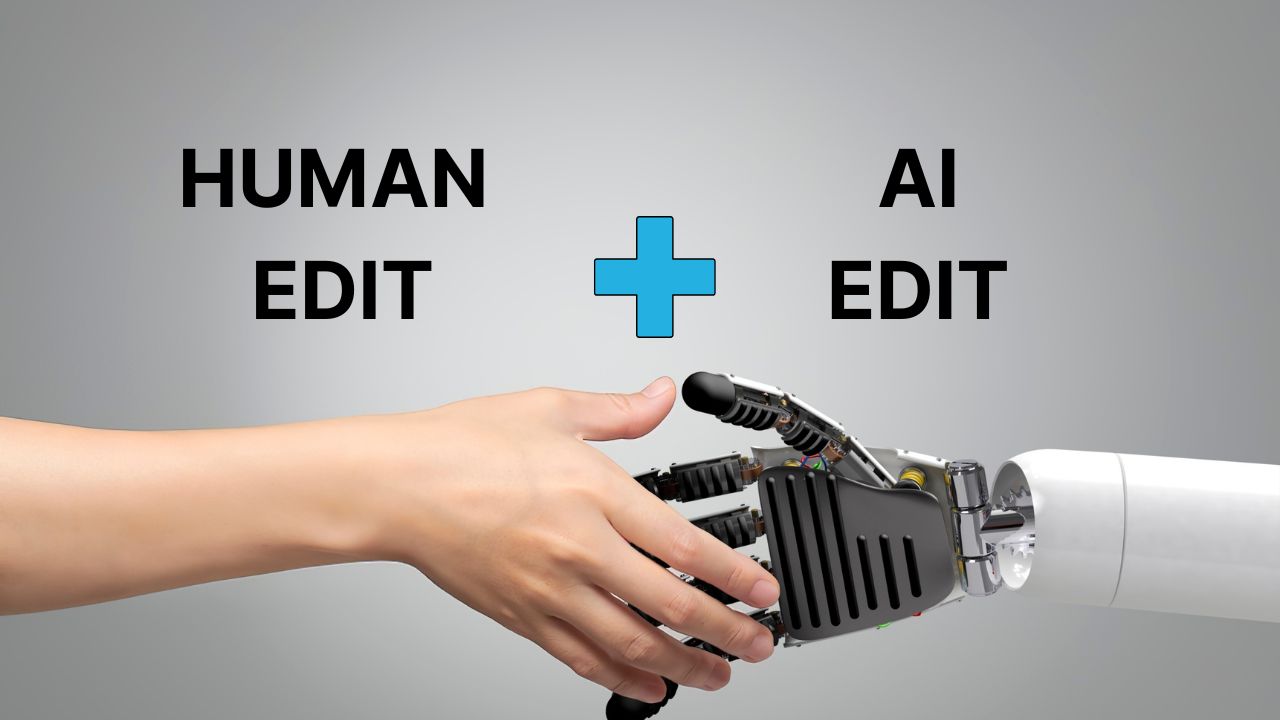
Research paper editing, a critical step in journal publishing, is now greatly simplified because of various artificial intelligence (AI) tools. Does that mean that researchers no longer need expert human editors? Can AI tools completely replace human insight? Let’s explore.
AI Tools: Boon for Native English Authors
Academic Editing Service: Why it Matters
AI Editing vs Human Editing: What Works Best
Key Differences: Human vs AI Editors
AI Tools: Boon for Native English Authors
AI writing tools like Grammarly, Paperpal, QuillBot, and ChatGPT have eased the writing process for non-native English scholars. But for native English speakers, these tools serve as editing aids in addition to simplifying the writing process. What authors need to be careful of is to not let their own writing be overpowered by these tools. To recognize where the boundary between “AI assisted” and “AI-led” writing lies, native authors should know the strengths and weaknesses of AI tools
What AI tools get right:
- Grammar checks
- Language enhancements
- Structured sentences
Where AI tools lack:
- Factual accuracy
- Nuance & context
- Emotional intelligence
- Originality & creative depth
Journals editors and peer reviewers easily spot such drawbacks. And this is also the reason for increasing reports of AI hallucinations in research papers. Moreover, the writing of an AI tool can appear robotic, which is to be expected because at the end of the day, AI tools have “artificial” brains!
When research papers are written in a monotonous tone with inferences lacking insights, it can be disappointing for journal editors and peer reviewers. So, human oversight becomes critical. And native English authors have the benefit of knowing how the language is supposed to naturally flow in writing. But scholarly writing is a different ballgame. And that’s where academic editors and editing services come in.
Academic Editing Service: Why it Matters
Scholarly writing warrants a rigorous level of refinement for logical progression of ideas in the text and overall quality of research. Academic editing services ensure that
- your research papers are free from language and grammar errors
- the clarity and coherence of your work shines throughout your research paper
- ambiguous writing is eliminated, making the paper easy to read
- academic standards set by journals are consistently satisfied
- your manuscript clears the first hurdle of desk checks and gets fast-tracked to the peer review process
This kind of support in the final stages of your publication journey can prove invaluable. A human-refined research paper aims to engage journal editors by tapping into their curiosity, presenting a story that’s interesting to read and persuading them that the proposed solution for the identified research problem is worth exploring. An AI tool, without any human involvement, may not help you achieve this. Even if the tool enhances the content, getting an expert editor’s opinion matters.
Here’s an example taken from an actual research paper draft. Let’s compare its AI-edited version with a human-refined version.
AI Editing vs Human Editing: What Works Best
This is an excerpt from the Discussion section of a research paper. Context: Biomedical research; Topic: Machine learning model for disease risk prediction. Let’s see how an AI editing tool changes the original draft and compare it with the human-revised text.
Raw researcher draft
In this study, we developed a machine learning model to predict disease risk. The results show that the model performed well with good accuracy. This indicates that machine learning could be useful in medical research.
The findings are similar to previous studies that also reported good performance of machine learning models. However, there are some limitations in this study. The sample size was small and the data were obtained from a single center.
In the future, more studies should be conducted with larger datasets to confirm the findings.
What we notice in this original writing:
- Short, safe sentences
- There’s minimal interpretation of results
- Engagement with existing literature is limited
- The text is written with caution; sounds repetitive
The original text does not present much scope for improvement with respect to data-specific interpretations and conclusions. It lacks clarity on what’s unique about the study, does not discuss what else is out there, and fails to explain how the study adds value to existing work.
This is how an AI tool rewrote the text.
AI-edited text
The results of this study show that the model performed well and achieved high accuracy. This suggests that machine learning can be useful for predicting disease risk. There are some limitations in this study, such as sample size. Future studies should include more data.
The repeated content is eliminated; but the text still does not provide any valuable information. Several AI limitations are obvious here:
- Overly generic interpretation of results
- No comparison with existing literature
- Study limitations are barely mentioned
- Lacks clarity on practical implications
Now let’s see what the outcome would be if a human editor worked on the original text.
Human-refined text
This study demonstrates that machine learning models can effectively predict disease risk, highlighting their potential role in supporting clinical decision-making. The observed performance aligns with prior studies, reinforcing the robustness of machine learning approaches across different research settings.
Nevertheless, the study is limited by its single–center design and modest sample size, which may affect generalizability. Future multi-center studies incorporating larger and more diverse datasets are warranted to validate and extend these findings.
There are significant differences in this editor-refined draft when compared with the AI-modified text:
- Findings interpreted are grounded in existing literature
- Limitations are discussed in a balanced, credible way
- Future research directions are clearly mentioned
- Scholarly voice is maintained, and the study impact appears strong
Key Differences: Human vs AI Editors
The above example shows that humans add a unique touch to retain the author’s original voice, something that AI tools are not capable of achieving yet. The table below summarizes a comparison of AI tools and human editors on different aspects of editing. The takeaway? AI has its benefits; but always maintain a good balance between human oversight and AI use.
| Editing aspect | AI tools | Human editors |
| Grammar | Strong | Strong |
| Logic & flow | Limited | Excellent |
| Journal fit | No | Yes |
| Ethical oversight | No | Yes |
| Manuscript formatting | No | Yes |
| Reviewer perspective | No | Yes |