
|
Getting your Trinity Audio player ready...
|
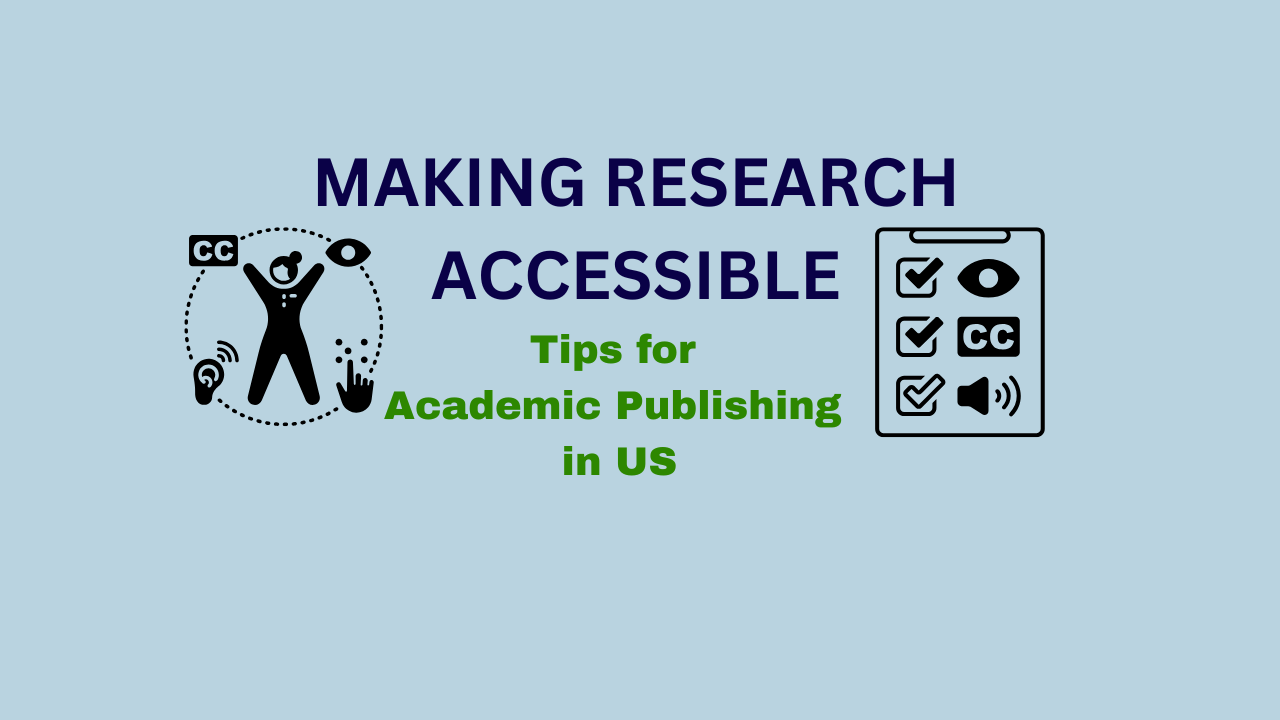
While discussions around academic publishing often address open access and research impact, an important facet that demands increasing attention is accessibility. The Americans with Disabilities Act (ADA) of 1990 [1] is a federal civil rights law in the US, which prohibits discrimination against individuals with disabilities in all areas of public life. While its initial ambit was physical spaces, it has been expanded to include digital environments as well, with ramifications for accessibility in research and publishing.
Given that 28.7% of the US population has some type of disability [2], US researchers should understand and implement accessibility best practices in their writing and publishing to comply with the ADA. In the spirit of this law, information should be accessible to individuals with disabilities. For researchers and publishers, this translates into an imperative to ensure that scholarly work can be engaged by all, regardless of sensory, cognitive, or physical abilities.
Consequences of non-compliance with the ADA
Why does accessibility matter in academic publishing?
How can US researchers and publishers make their work more accessible?
Consequences of non-compliance with the ADA
Publishers must be cognizant of ADA requirements to avoid unfavorable repercussions. Non-compliance could lead to lawsuits, penalties, and reputational damage from public backlash and negative press. Further, an inaccessible digital platform would translate into the exclusion of potential customers, resulting in revenue losses.
Why does accessibility matter in academic publishing?
Academic publishing must prioritize accessibility for reasons beyond legal considerations. When research is accessible, it reaches a wider audience. This includes scholars with disabilities. In fact, everyone stands to benefit from accessible features such as clear language and structured headings. And a broader reach naturally leads to greater potential for citations, real-world impact, and even meaningful collaborations.
Second, from the point of view of ethical responsibility, excluding a segment of the population from accessing knowledge goes against the core mission of academia, which is the dissemination of knowledge!
As technology advances, the ways in which we consume information will continue to change. For academic publications to remain relevant and usable across various platforms and assistive technologies in the future, accessibility issues must be addressed.
How can US researchers and publishers make their work more accessible?
Here are the salient points to consider throughout the writing and publication process for accessibility in research.
1. Accessible writing practices
Authors should use clear and concise language, avoiding overly complex jargon. Specialized terminology should be explained when first introduced.
Clear, hierarchical headings to structure the document help screen reader users who navigate documents via headings.
Bulleted or numbered lists should be used for sequential information or groups of items. This enhances readability and is easily interpreted by assistive technologies.
2. Visual content accessibility
Every image, graph, or complex figure needs concise yet descriptive “alternative text” (Alt Text) that conveys the essential information or purpose of the visual for screen reader users. For example, don’t just say “Graph”; describe what the graph shows, including its key trends and main conclusions.
For very complex graphs, diagrams, or infographics, a longer, more detailed description should be provided in the main text or an appendix, in addition to alt text. Similarly, complex equations and mathematical notations should be formatted appropriately to be made accessible (MathML, LaTeX with proper conversion).
For color visuals, it is essential to ensure sufficient contrast between text and background colors and avoid relying solely on color to convey information. Authors and publishers must carefully consider readers with color vision deficiency or “color blindness” (Did you know that 4.5% of the world’s population have color vision deficiency?[3]). Tools are available online to check color contrast ratios (e.g., Coblis [4]).
3. Document format and preparation
Authors (and journals) should use standard fonts and legible sizes. As for file formats, while PDF is a ubiquitous format, not all PDFs are accessible. PDFs should be tagged as they contain a hidden structural layer that allows screen readers and other assistive technologies to interpret the document’s layout and content correctly. Where possible, publishers may offer options for HTML versions alongside PDFs. HTML is inherently more accessible and adaptable for various devices and assistive technologies.
Publishers could also consider enhanced publications with multimedia accessibility features and machine-readable formats.
4. Accessible and seamless “author experience” in publishing platforms
Academic publishers have a key role to play in ensuring accessibility in publishing workflows. Publishers should ensure that their manuscript submission systems are accessible to authors with disabilities. Their platforms should ideally follow best practices such as the Web Content Accessibility Guidelines (WCAG) [5].
Journals and publishers should articulate their commitment to accessibility and provide guidelines for authors. Editorial teams should be trained about accessibility best practices, and regular audits of submission systems should be conducted to address accessibility barriers.
Publishing tools and platforms can integrate real-time accessibility checkers (e.g., automated alt text generation, color contrast checkers) directly into the workflow to simplify the process and reduce the technical burden on authors.
Closing thoughts
Achieving true accessibility in US academic publishing is not a solo endeavor but a collaborative effort. US researchers should proactively learn about and implement accessibility best practices. When selecting their target journal, researchers should consider journals’ stated accessibility policies. Open access journals that share accessible preprints and supplementary materials, maintain accessible repository versions, etc., would be preferable over closed access journals.
Meanwhile, publishers must invest in the necessary technology, training, and workflows to produce truly accessible content. Finally, universities and libraries also have a role: providing training and resources on accessible authoring for their faculty and students.
For authors and publishers, enhancing accessibility in the academic publishing ecosystem is important for moving beyond mere legal compliance toward upholding the fundamental values of equity and intellectual pursuit.
References
1. Americans with Disabilities Act (ADA) of 1990 https://www.access-board.gov/about/law/ada.html
2. Disability impacts all of us https://www.cdc.gov/disability-and-health/articles-documents/disability-impacts-all-of-us-infographic.html
3. About color blindness https://www.colourblindawareness.org/colour-blindness/
4. Coblis – color blindness simulator https://www.color-blindness.com/coblis-color-blindness-simulator/
5. WCAG 2 overview https://www.w3.org/WAI/standards-guidelines/wcag/