
|
Getting your Trinity Audio player ready...
|
Why use a plagiarism checker? Academic plagiarism has serious consequences: you could receive a failing grade, fail the entire course, get suspended or even expelled from your university/institution. Students therefore need to be really careful while submitting assignments, essays or research reports. Naturally, the best guard against being accuse of plagiarism is to simply not plagiarize and write everything in your own words, using your own thoughts and ideas without copying from anyone else. But you know that in research, there are times when you are inadvertently duplicating text from another source. Like, how much can you rephrase “The significance threshold was P < .05” or “The tubes were centrifuged at 1000xg”? Here’s where a good plagiarism checker comes in handy.
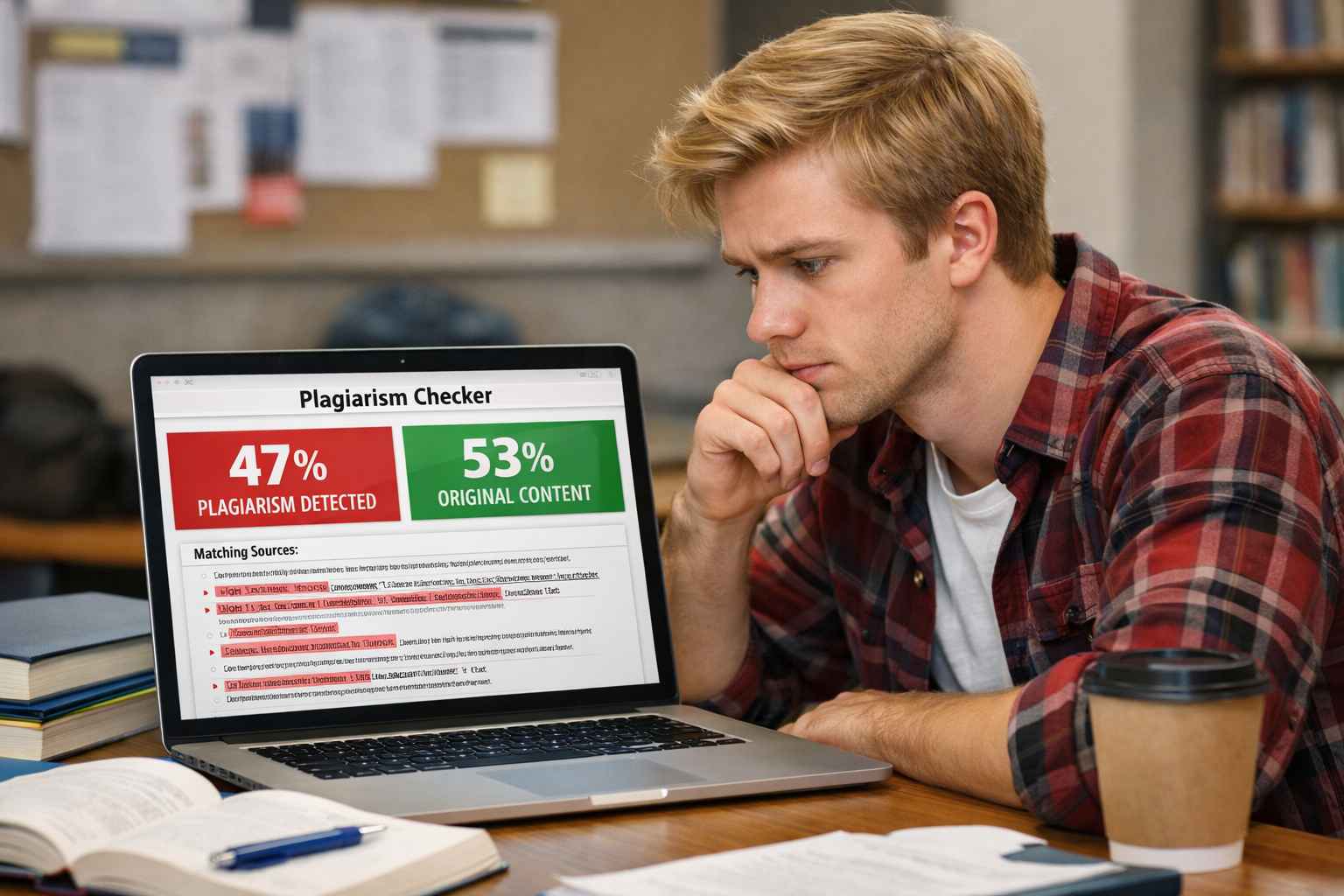
Plagiarism checkers allow you to see exactly what parts of your writing appear to duplicate other sources. You can then
- Rewrite flagged text
- Enclose text in quotation marks and add a suitable citation
- Judiciously ignore flagged text because those are standard academic phrases and expressions
Choose the right plagiarism checker and use it wisely before submitting any of your writing, and safeguard your grades as well as academic reputation.
Paperpal
Developed specifically for research and academia, Paperpal’s plagiarism checker scans over 99 billion webpages and 200 million open-access articles. It provides colour-coded results to indicate how much your text overlaps with other sources, and even indicates if some text is similar to multiple existing sources.
Scribbr
Scribb’s plagiarism checker is integrated with a citation generator so that you can efficiently add additional citations to your writing. It also gives you the option to upload your previous assignment or even a classmate’s assignment (if you can get it!) so that you can check for overlap with these texts too, even though they are not formally published.
Grammarly
Grammarly’s plagiarism checker tool, which is AI powered, gives you not just similarity scores but also real-time feedback on grammar and style. Users get not just a plagiarism score but also ratings on spelling, punctuation, word choice, readability, etc.
Quillbot
Quillbot’s plagiarism checker can detect plagiarism in more than 100 languages. Like Scribbr, this plagiarism checker also has an integrated citation generator. The tool also accepts .html files in addition to .docx and .txt.
GPTZero
This plagiarism checker can be integrated with online classroom tools like Canvas and Google Classrooms. It scans over 100 million journal articles, books, research documents and websites. As its name implies, it also checks for AI-generated text simultaneously (note that Paperpal, Grammarly, etc. also offer AI detectors).
Frequently Asked Questions
Are plagiarism checkers free?
Paperpal allows users to scan 7000 words per month for free (the average research paper is 2000-3000 words). Grammarly offers you 10,000 characters (which works out to around 1500-2000 words) free of charge. Others have various plans too.
What should I do if I get a high score in a plagiarism checker?
If your plagiarism checker indicates that a large amount of text duplicates existing sources, you need to
- Review the text carefully to check if these are standard academic phrases (e.g., All participants gave informed consent) or actual ideas, opinions, or findings from other authors.
- Enclose text in quotation marks or format it as a block quote and add a relevant citation. This practice is more common in fields like history, ethics, or literature; it’s less common in the biomedical and physical sciences. So use it judiciously.
- Rewrite highlighted text in your own words, not just “synonym swapping.” For instance, “There is a correlation between in utero alfetrocin exposure and fetal weight at 32 weeks of gestation (Papodopoulous & Zhang, 2008)”. Here, you mustn’t just replace “correlation” with “relationship”, which seems like an easy fix. Instead add your own opinion on the study concerned: is it well designed? Is the evidence strong or weak? Are there any serious limitations that affect the way this correlation should be interpreted? Add your own viewpoint or interpretation of the study.
Can I skip using a plagiarism checker?
It isn’t advisable to skip a plagiarism check of your assignment or research paper. Nowadays, skipping a plagiarism check of your academic paper is like skipping a spellcheck. Of course, some people write really well and never make typos or spelling mistakes, but why take a chance? You may feel that your ideas are 100% your own, but there are hundreds of thousands of researchers and authors in your field. Inadvertent plagiarism isn’t so uncommon. For your own peace of mind, run your writing through a plagiarism scanner so that you can submit it with confidence that you won’t be accused of academic misconduct.