
|
Getting your Trinity Audio player ready...
|
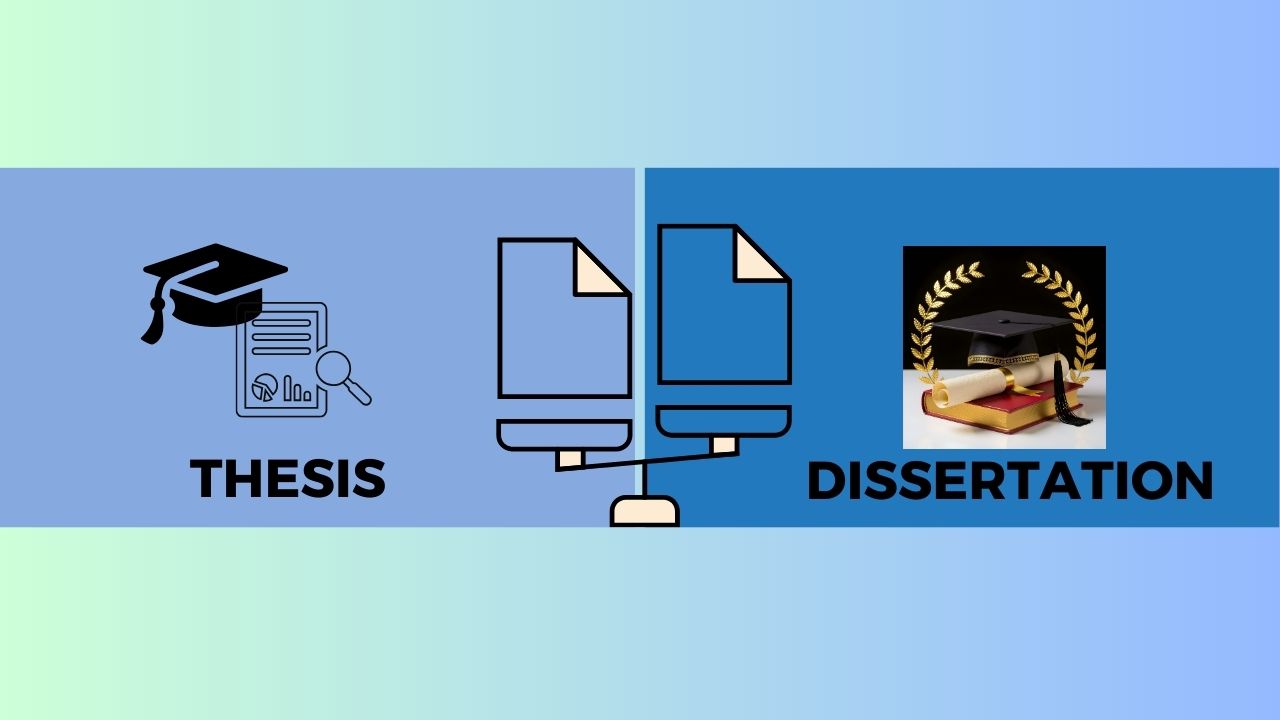
In your graduate studies, you might need to churn out a thesis or dissertation, two terms that are often used interchangeably. The definitions for both differ by region or institute. For instance, in the US, a dissertation refers to the research document you need to prepare to obtain a PhD, whereas in other countries (such as the UK), a dissertation is the document you compile to obtain your master’s degree.
Key Differences: Thesis vs. Dissertation
Similarities between theses and dissertations
Career Implications for Thesis vs. Dissertation
What is a Thesis?
In the US, a thesis typically marks the culmination of a master’s degree program, demonstrating a student’s mastery of existing research in a specific field. It is a critically written piece of scholarly work that showcases the student’s knowledge and understanding of a topic they researched as part of the program. A master’s student has a supervisor who guides the process, ensuring proper conduct and academic rigor. Writing a thesis can be seen as a way to prepare students for professional roles or further doctoral studies. The process of writing a thesis helps hone skills such as literature review and coherent argumentation, which are foundational for academic writing.
Let’s take a look at the differences between a dissertation and thesis (and if indeed there are any!) while highlighting their shared purpose in academic journeys.
To write your thesis, you will need to focus on a specific research question, perform a literature review, collect and analyze data, and present your findings in a structured manner. However, the specific requirements for a thesis may vary by academic institution, department, and program.
Note that in the UK, however, a thesis is a requirement of a PhD program.
What is a Dissertation?
In the US, the submission of a dissertation marks the completion of doctoral (PhD) program. The dissertation requires original research that contributes novel insights to the field. It is a rigorous endeavor that spans years. Every institute has guidelines for structuring and formatting a dissertation.
Once again, this is flipped in other countries, such as the UK, Australia, and India, where a dissertation is a shorter academic piece, written to fulfil master’s (or occasionally, bachelor’s) degree requirements.
Key Differences: Thesis vs. Dissertation
Theses and dissertations differ primarily in terms of academic level, purpose, and scope. It is important to remember that regional variations exist (i.e., reversed in some European contexts). Table 1 presents, in a nutshell, the salient differences between the two. In this snapshot, we are considering the terms in a US context.
Table 1. Key Differences: Thesis vs. Dissertation
| Thesis | Dissertation | |
| Degree level | Master’s degree | Doctorate (PhD) |
| Purpose | Demonstrate knowledge of existing research | Contribute original research |
| Research type | Literature synthesis, analysis | New data collection, experiments |
| Length | 50–100 pages | 150–300 pages (or more) |
| Originality | Builds on prior work | Novel contributions |
| Defense | Presentation to supervisor/committee | Comprehensive oral exam |
| Timeframe | 6–12 months | 2–5 years (or more) |
Considering regional, institutional, or even departmental differences in the use of the terms “thesis” and “dissertation,” you must always consult the relevant university handbooks or guides for specific requirements and style guidelines to follow. When in doubt, you can check with your supervisor, university librarian, or even students who have recently submitted their theses/dissertations at your department.
Similarities between theses and dissertations
Both bodies of work are mandatory requirements to graduate from specific academic programs. Theses and dissertations both require that the student have a good understanding of the research problem and critical analytical skills. Finally, it goes without saying that both require academic integrity, with absolutely no place for misconduct of any type, including plagiarism.
Career Implications for Thesis vs. Dissertation
A master’s thesis signals readiness for applied research. It equips master’s graduates for industry roles, teaching, and further research. These projects emphasize efficient literature analysis and clear reporting and lay the groundwork for critical thinking and crisp academic writing. Meanwhile, dissertations entrench PhD holders firmly in academia, setting them up for research roles and over time, even tenure. The original contributions from dissertations often lead to high-impact journal publications, grant funding, and leadership in research centers.
Writing theses, dissertations, and research papers help build skills such as critical thinking, data analysis, data visualization, and research communication.
FAQs
Q1. Is a thesis and dissertation the same?
A. Not exactly; terms vary by country and institution, but both are scholarly treatises. Master’s versions synthesize the literature, while PhD ones add original research. Be sure to check your program’s guidelines over labels.
Q2. Is a thesis harder than a dissertation?
A. Difficulty depends on context, but PhD versions demand more originality and time. Master’s work emphasizes analysis; both challenge critical skills uniquely.
Q3. Is a dissertation only for PhD?
A. Typically, no. US PhDs use “dissertation,” whereas British master’s use it too. Just remember that PhD work always requires novelty, regardless of the name of the research document you submit.
Q4. Does a bachelor’s degree require a thesis or a dissertation?
A. This is rare. Honors programs may include short capstones resembling dissertations, but full versions are graduate-level. Undergraduate degrees focus on coursework rather than extensive research.