
|
Getting your Trinity Audio player ready...
|
Step-by-Step Process in Research Explained
Iterative Nature of Research Procedure Steps
Closing Thoughts: Day Science and Night Science
What is Research?
Research is a systematic process of investigating questions or problems to generate new knowledge. The aim of research is to push the boundaries of what is known about the physical, biological, or social world through structured collection and analysis of information. Whether in a laboratory, field setting, or through other systematic methods, research contributes to humanity’s collective knowledge. One can discover knowledge through experience, observations, or reading a book. But research is different these forms of discovering knowledge because it uses a systematic process known as the “scientific method.” To better understand the stages in the research process, we must learn about the scientific method.
The scientific method is an empirical framework for acquiring knowledge through observation, hypothesis testing, and experimental validation. It has served as the foundation for rigorous inquiry since the 17th century and remains central to how researchers across disciplines conduct investigations.1
The scientific method involves developing a hypothesis (an educated guess or prediction) about a topic. Research requires putting this hypothesis to the test and evaluating the outcomes in relation to both the original prediction and real-world conditions.
Step-by-Step Process in Research Explained
Although the exact procedures vary across fields, research procedure steps under the scientific method are essentially similar.
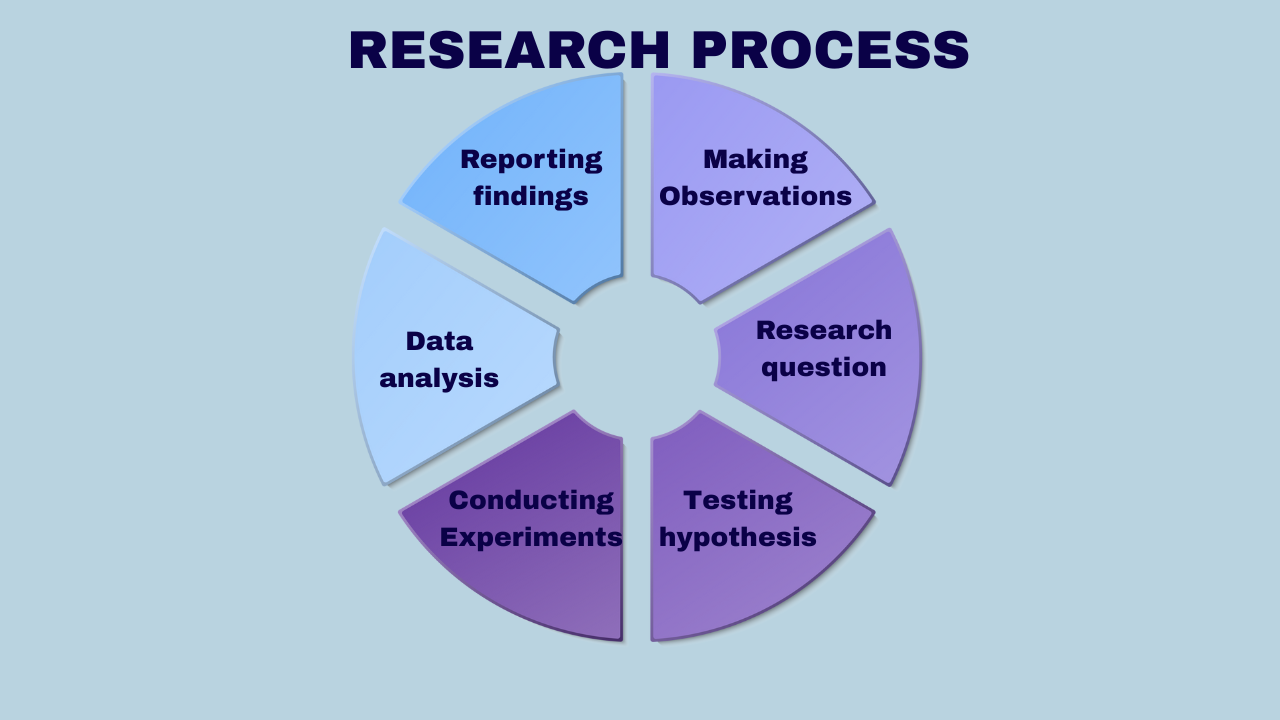
Step 1: Making observations
Research procedure steps begin with careful observation of natural phenomena or existing problems in your field. Before experimentation, you must establish what you will study by examining the existing literature to understand what has already been tested and what questions remain unanswered. At this foundational phase, you will need to immerse yourself in peer-reviewed literature and identify gaps or inconsistencies in current knowledge. For example, in biomedical research, an observation might involve noticing that certain patient populations respond differently to a standard treatment.
Step 2: Defining a research question
Choosing the problem primarily determines what all you will achieve in your research pursuit. Once you have identified your area of interest, you will need to articulate a clear research question. Asking the “right” question lays the foundation for a successful research project. A research question must be specific, measurable, and testable. Rather than vague inquiries, effective research questions follow formats such as “What is the effect of X on Y?” Poorly formulated questions lead to wasted resources and inconclusive results. For example, “Is exercise good for health?” is too vague and broad. A specific, measurable, and directly testable question would be “What is the effect of aerobic exercise frequency on resting heart rate in sedentary adults over eight weeks?”
Step 3: Developing a testable hypothesis
A hypothesis is a proposed explanatory statement based on limited evidence, serving as a starting point for further investigation. Unlike casual speculation, a scientific hypothesis must be testable (you can design an experiment to evaluate it), falsifiable (it can be proven wrong), and useful (the outcome provides valuable information). Hypotheses are typically structured as “if–then” statements that clearly identify independent and dependent variables. For example, “If middle-aged people perform aerobic exercise for 1 hour daily, then their heart rate variability increases” contains a clear causal relationship that can be experimentally evaluated. The hypothesis guides your experimental design, shapes your data collection strategy, and determines which statistical methods you will employ.
Step 4: Designing and conducting the experiment
Experimental design is where your hypothesis moves from theoretical prediction to empirical investigation. This step requires careful consideration of multiple factors: defining your variables (independent and dependent variables), selecting appropriate research methods, determining sample size, establishing control conditions, and implementing randomization to minimize bias. The methodology must be rigorous and reproducible, so that others researcher following your exact procedures can obtain comparable results. In controlled experiments, researchers manipulate one or more independent variables while keeping other factors constant to isolate the effect of the treatment. For qualitative or descriptive research, the approach differs but maintains the same commitment to systematic, unbiased data collection. Throughout data collection, you must remain objective, allowing evidence to guide conclusions rather than permitting preconceived ideas to distort observations.
Step 5: Analyzing data and drawing conclusions
Once data collection is complete, you must systematically analyze your findings using appropriate statistical and analytical methods. You will determine whether your data support or refute the original hypothesis. If the data consistently support the hypothesis across multiple experiments, confidence in that hypothesis increases. If findings contradict the hypothesis, it must be rejected or modified, leading to new questions and further testing. Statistical significance, effect sizes, and confidence intervals all inform whether observed differences are meaningful or attributable to chance.
Step 6: Reporting the findings
The final step involves sharing your results. This typically happens through the publication of the findings in a research paper in an academic journal, presentation of your findings at an academic conference, or submission to a pre-print repository. Peer review is the process whereby scientists with expertise in your field evaluate your methodology, analysis, and conclusions, identifying potential mistakes, biases, or limitations. This external scrutiny strengthens the validity and credibility of findings. Peer-reviewed publications signal to the scientific community that research meets established standards of rigor. Once published, your findings become part of the collective knowledge base, enabling other researchers to build upon, replicate, or challenge your work.
Iterative Nature of Research Procedure Steps
Rather than a linear sequence, the scientific method represents a cyclical process of critical thinking, evidence gathering, and refinement. Results from one experiment generate new questions, which may prompt you to refine your hypotheses and add additional investigations. Similarly, while you have to review the literature during the initial stages of the scientific method, when defining the problem, formulating a research question, and developing a hypothesis, you will find yourself revisiting the literature throughout the research process. You will need to refer to the literature for guiding the development of the experimental design and methodology, analyzing results to compare your findings with existing studies, and when discussing your conclusions to contextualize the study contributions to the field.
Closing Thoughts: Day Science and Night Science
Nobel laureate François Jacob popularized the concept of “day science” and “night science”: two complementary phases of the scientific process.2,3 Day science involves structured, hypothesis-driven work, analyzing data with established protocols, and drawing logical conclusions (as described in the preceding sections). Night science, by contrast, entails unstructured exploration—wandering through ideas, making associative leaps, and generating creative hypotheses, often during off-hours like lying in bed. Successful researchers alternate between these modes, using night science’s freedom to spark innovation and day science’s rigor to validate it!
Frequently Asked Questions
Q1. What is the process of research?
A. Research is a systematic, methodical inquiry involving observation, hypothesis formation, experimentation, data analysis, and peer review. It follows the scientific method to generate reliable, evidence-based knowledge and advance understanding within academic and professional domains.
Q2. What is the first step in the research process?
A. The first step is observation and problem identification. Researchers examine natural phenomena, review existing literature, and identify gaps in current knowledge. This foundational phase generates research questions that guide the entire investigation.
Q3. What is the research process model?
A. The research process model is a cyclical framework comprising six interconnected steps: observation, hypothesis formulation, experimental design, data collection, analysis, and sharing the results.
References
1. Voit EO. Dimensions of the scientific method. PLoS Comput Biol 2019;15(9):
e1007279. https://doi.org/10.1371/journal.pcbi.1007279
2. Yanai I, Lercher M. What is the question? Genome Biol. 2019;20(1):289. doi: 10.1186/s13059-019-1902-1.
3. Yanai I, Lercher M. Night science. Genome Biol. 2019;20(1):179. doi: 10.1186/s13059-019-1800-6.