

|
Getting your Trinity Audio player ready...
|
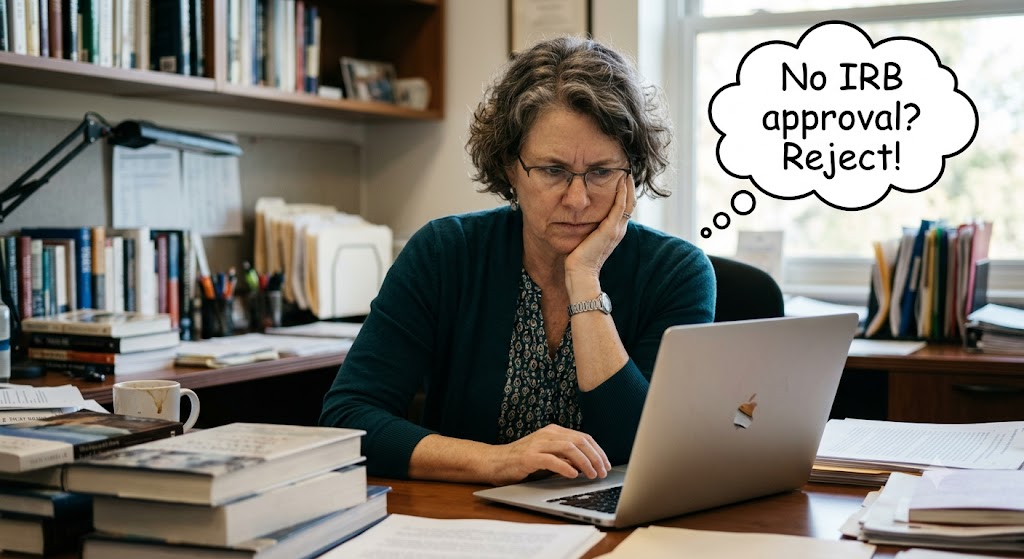
A desk rejection happens when a journal editor declines a manuscript without sending it out for peer review. Editors typically spend only a few minutes on this initial screening, and in that short window, certain issues stand out immediately and end the process before it begins.
Understanding what triggers these snap decisions can help authors avoid losing months of work to an entirely preventable mistake. This article breaks down the six most common red flags that cause immediate desk rejection, explains why each one matters to editors, and offers practical steps to fix them before submission.
Contents
- What Counts as a Desk Rejection, and How Common Is It?
- The Six Red Flags That Trigger Immediate Desk Rejection
- How Can Authors Reduce the Risk of Desk Rejection Before Submitting?
- Key Takeaways
- Frequently Asked Questions
What Counts as a Desk Rejection, and How Common Is It?
A desk rejection is an editorial decision made before peer review, usually within 1-4 weeks of submission. Many journals reject a substantial share of submissions this way, often 30-70% depending on the field and the journal’s selectivity.
Desk rejections are handled by the editor in chief, an associate editor, or increasingly, an editorial office screening checklist supported by software. The screening is meant to filter out manuscripts that are unsuitable, incomplete, or non-compliant, so that reviewers only spend time on submissions with a realistic chance of publication.
The table below summarizes the six red flags covered in this article.
| Red Flag | Stage Detected | Typical Fix Time |
| Missing ethical declarations or metadata | Submission checklist screening | 1 to 3 days |
| Formatting not per journal guidelines | Editorial office screening | 1 to 5 days |
| Mismatch with aims and scope | Editor’s initial read | Requires new target journal |
| Unreadable or corrupted figure files | Technical file check | Same day |
| Extremely high plagiarism concentration | Similarity software screening | Requires rewriting |
| Lack of novelty or contribution | Editor’s initial read | Requires new data or angle |
The Six Red Flags That Trigger Immediate Desk Rejection
Each of the following issues can independently cause an editor to reject a manuscript without review. Some are administrative, some are ethical, and some relate to the substance of the research itself, but all are avoidable with careful preparation.
1. Missing Ethical Declarations or Metadata
Journals require a defined set of ethical and administrative declarations before a manuscript can even be logged as complete. These typically include:
- Ethics committee or institutional review board approval details, including approval number and date
- Informed consent statements for studies involving human participants
- Animal welfare compliance statements for studies involving animal subjects
- Conflict of interest and funding disclosures
- Data availability statements and author contribution statements
When any of these are missing, blank, or copied incorrectly from a template, the submission is usually flagged automatically or during the editorial office’s manual checklist review. Because ethical compliance is a non-negotiable publishing standard, editors rarely give authors the benefit of the doubt; the manuscript is returned or rejected outright, and the clock resets once the missing information is supplied and the paper is resubmitted.
How to avoid it:
- Download the specific journal’s author guidelines and ethics checklist before writing the cover letter
- Complete every declaration field explicitly; do not leave a field as “not applicable” unless it truly is
- Cross check author names, affiliations, and ORCID identifiers against what was entered in the submission system
2. Manuscript Not Formatted per Journal Guidelines
Formatting problems are among the most common, and most easily avoided, reasons for desk rejection. Editors interpret a poorly formatted manuscript as a sign that the author has not read the guidelines carefully, which raises doubts about the rigor of the research itself.
Common formatting issues:
- Word count exceeding the journal’s stated limit for the article type
- Reference style that does not match the journal’s required citation format
- Missing structured abstract, keywords, or highlights where required
- Incorrect section order, such as combining results and discussion when the journal requires them separate
- Line numbering or blinding requirements not followed for double-blind review
How to avoid desk rejection for formatting errors:
- Use the journal’s official template or sample article as a formatting reference
- Run reference lists through citation management software set to the exact journal style
- Use a professional manuscript formatting service such as Editage when journal guidelines are lengthy or complex, or when you are short on time.
3. Mismatch with Journal’s Aims and Scope
Every journal defines a scope statement describing the topics, disciplines, and article types it publishes. A manuscript that falls outside this scope, even if it is methodologically sound, is rejected because the editor knows the target readership and reviewer pool will not be a good fit.
This mismatch often happens when authors submit to high-impact, broad-scope journals hoping for visibility, or when they reuse a cover letter from a previous submission without checking whether the new target journal actually covers their subfield.
| Scenario | Why It Fails Scope Check |
| Clinical case report sent to a basic science journal | Journal only publishes mechanistic or laboratory research |
| Regional policy study sent to a global health journal | Journal requires findings with cross-country relevance |
| Engineering methods paper sent to a clinical journal | No clinical application or patient outcome discussed |
How to avoid desk rejection for scope mismatch:
- Read at least three to five recently published articles in the target journal, not just the scope statement
- Check whether the journal has published similar study designs or methodologies in the last two years (Editage’s free Journal Finder tool can help with this)
- Address scope fit directly in the cover letter, explaining why the study matches the journal’s readership
4. Figure Files Unreadable or That Cannot Be Opened
Editorial systems often fail to render figures correctly when files are corrupted, saved in unsupported formats, or compressed to the point of illegibility. If an editor cannot open or read a figure, they cannot evaluate the manuscript’s core data, and the submission is returned as incomplete.
Typical technical failures:
- Vector files saved with embedded fonts or layers that do not convert properly to PDF
- Images pasted into Word at low resolution, becoming pixelated or unreadable when printed
- File formats not accepted by the submission portal, such as unconverted native software files
- Corrupted uploads caused by unstable internet connections during submission
How to avoid it:
- Export figures in the exact resolution and file format specified in the author guidelines, typically TIFF or high-resolution PNG
- Open every figure file on a separate device after export to confirm it displays correctly
- Keep individual figure file sizes within the portal’s upload limits to prevent silent corruption
5. Extremely High Plagiarism Score Concentrated in One or Two Sources
Similarity checking software flags every submission, and some overlap is normal, particularly in the methods section where standard procedures are described in similar language across studies. What triggers rejection is not a moderate, distributed similarity score, but an extremely high score concentrated almost entirely in one or two prior papers.
This pattern suggests that large blocks of text, or the overall structure and argument, were lifted from a specific source rather than coincidentally overlapping due to shared terminology. Editors treat this as a serious integrity concern rather than a formatting issue, and it can result in rejection alongside a formal note in the author’s record with the publisher.
Key distinctions editors look for:
- Overlap spread thinly across many references usually reflects normal field terminology
- Overlap concentrated in one or two sources usually reflects direct copying or inadequate paraphrasing
- Overlap in the introduction or discussion is treated more seriously than overlap in standard methods language
How to avoid desk rejection for paraphrasing:
- Run the manuscript through similarity detection software before submission and review the source breakdown, not just the overall score
- Paraphrase in your own words and cite properly rather than lightly editing sentences from a single source
- Avoid recycling large sections from your own previously published work without appropriate citation and permission
6. Lack of Novelty or Study Contribution
Even a well-designed and properly reported study can be desk rejected if the editor concludes it does not add anything new to the field. This is a judgment call, and it is the flag most likely to feel subjective to authors, but it follows a predictable pattern.
Editors commonly cite lack of novelty when:
- The study replicates prior work in a different population without a stated reason for the replication
- The research question has already been answered conclusively by larger or more rigorous prior studies
- The manuscript does not clearly state what is new compared to the existing literature
- The sample size, methodology, or setting is too narrow to justify the claims made in the conclusion
How to avoid desk rejection for lack of novelty:
- State the specific contribution and gap being addressed explicitly in the abstract and in the final paragraph of the introduction
- Cite the most closely related prior studies and explain precisely how the current study differs
- Clearly highlight how the findings extend, support, or contradict existing research in the Discussion section
- Frame replication studies around a clear rationale, such as testing generalizability in an underrepresented population
How Can Authors Reduce the Risk of Desk Rejection Before Submitting?
Authors can reduce desk rejection risk substantially by running a structured pre-submission check rather than relying on a final proofread alone. The checklist below covers the most frequently missed items.
| Checklist Item | Confirmed? |
| Ethics approval, consent, and conflict of interest statements completed | |
| Manuscript formatted to the exact journal template and reference style | |
| Scope fit verified against recently published articles in the journal | |
| All figures opened and verified in the required file format | |
| Similarity report reviewed for source concentration, not just total score | |
| Novelty and contribution stated explicitly in the introduction |
Key Takeaways
- Desk rejection happens before peer review and is usually caused by preventable administrative or scope related issues rather than the quality of the research itself
- Missing ethics declarations, formatting errors, and unreadable figure files are technical problems that can be eliminated with a careful pre-submission checklist
- A high plagiarism score concentrated in one or two sources is treated as an integrity concern and is far more serious than low overlap spread across many references
- Clearly stating the study’s novelty and confirming scope fit with the target journal are the two most effective ways to avoid a judgment based rejection
Frequently Asked Questions
How long does it take for a journal to issue a desk rejection?
Most desk rejections arrive within one to four weeks of submission, though some journals with automated screening tools respond within a few days.
Can I resubmit a manuscript to the same journal after a desk rejection?
Resubmission policies vary by journal; some allow a revised resubmission after fixing the cited issue, while others require submission as an entirely new manuscript.
What plagiarism percentage is considered acceptable for journal submission?
Most journals consider an overall similarity score under fifteen percent acceptable, provided the overlap is spread across many sources rather than concentrated in one or two papers.
Does a desk rejection count against an author’s publication record?
A standard desk rejection for scope or formatting reasons does not appear on an author’s record, but rejections tied to confirmed plagiarism or ethical violations may be documented by the publisher.
How do I check if my manuscript fits a journal’s aims and scope?
Read several recently published articles in the journal and compare their study design, population, and methodology to your own manuscript before submitting.
What file formats do journals typically require for figures?
Most journals require high-resolution TIFF, EPS, or PNG files, with specific minimum resolution requirements stated in the author guidelines.
Why do journals reject papers for lacking novelty even when the methodology is sound?
Journals prioritize publishing findings that advance the field, so a methodologically sound study that only confirms existing, well established conclusions may not meet the novelty threshold editors require.
Can incomplete author contribution statements cause a desk rejection?
Yes, many journals require a completed author contribution statement as part of the submission checklist, and an incomplete one can cause the manuscript to be returned before review.