

|
Getting your Trinity Audio player ready...
|
- What is peer review?
- Peer review process in journals
- Types of Peer Review
- What is Open Peer Review?
- What is Post Publication Peer Review?
- How to pass peer review
- What is the difference between peer review and editorial review?
- Frequently Asked Questions
What is peer review?
Peer review is the process by which journals assess the quality of any submitted article and whether it is suitable for publication, by taking expert opinions from other seasoned researchers who have expertise in that particular topic.
The main functions of peer review are to:
- Determine the novelty of the study and its theoretical/clinical/practical contributions
- Assess the methodology and analysis for rigor and robustness
- Validate the scientific claims made by the study
- Examine whether the article is suitable for publication in that particular journal
- Provide feedback and suggestions for improvement
Peer review process in journals
The typical peer review process in scientific journals is as follows:
- Author submits a paper
- Journal staff do a basic check for completeness and compliance (e.g., all declarations submitted, formatting guidelines followed)
- Editor-in-chief/domain editor/associate editor does a preliminary check for fit and quality. Papers with obviously poor methodology or scope mismatch are rejected at this stage.
- If manuscripts pass step 3, the editor-in-chief/domain editor/associate editor selects 2-3 independent experts to act as peer reviewers.
- Peer reviewers evaluate the paper for scientific merit, novelty, and contributions. Each reviewer independently makes a recommendation as follows:
- Accept without changes
- Resubmit with minor revisions
- Resubmit with major revisions
- Reject (no chance to resubmit)
- Editor-in-chief/domain editor/associate editor collates the peer review comments and makes a final decision.
- Editor-in-chief/domain editor/associate editor communicates peer review feedback + their decision to the author
- Author revises and resubmits the paper
- Paper may undergo one more round of peer review to confirm all necessary changes have been made.
- Editor-in-chief/domain editor/associate editor decides whether to accept the paper for publication or return it to the author for further revisions.
Types of Peer Review
The three main types of peer review are single-blind, double-blind, and triple-blind peer review, explained in the table below.
| Aspect | Single-Blind Peer Review | Double-Blind Peer Review | Triple-Blind Peer Review |
| Reviewer knows author identity? | Yes | No | No |
| Author knows reviewer identity? | No | No | No |
| Editor knows author identity? | Yes | Yes | No (or minimized during review process) |
| Reviewer anonymity | Anonymous to author | Anonymous to author | Anonymous to author and the editor |
| Author anonymity | Not anonymous to reviewer or editor | Anonymous to reviewer but not the editor | Anonymous to reviewer and editor |
| Main purpose | Protect reviewers from author influence while allowing reviewer context about authors’ prior publications | Reduce bias based on author name, institution, gender, or reputation | Further minimize bias by limiting editor influence as well |
| Advantages | Reviewer can assess author’s prior work and expertise; simpler to manage | Greater fairness and reduced reviewer bias | Maximum attempt at impartiality and fairness |
| Disadvantages | Risk of reviewer bias based on author identity or institution | Complete anonymity can be difficult to maintain; reviewers may guess authors | Logistically complex; difficult to fully implement |
| Administrative complexity | Low | Moderate | High |
What is Open Peer Review?
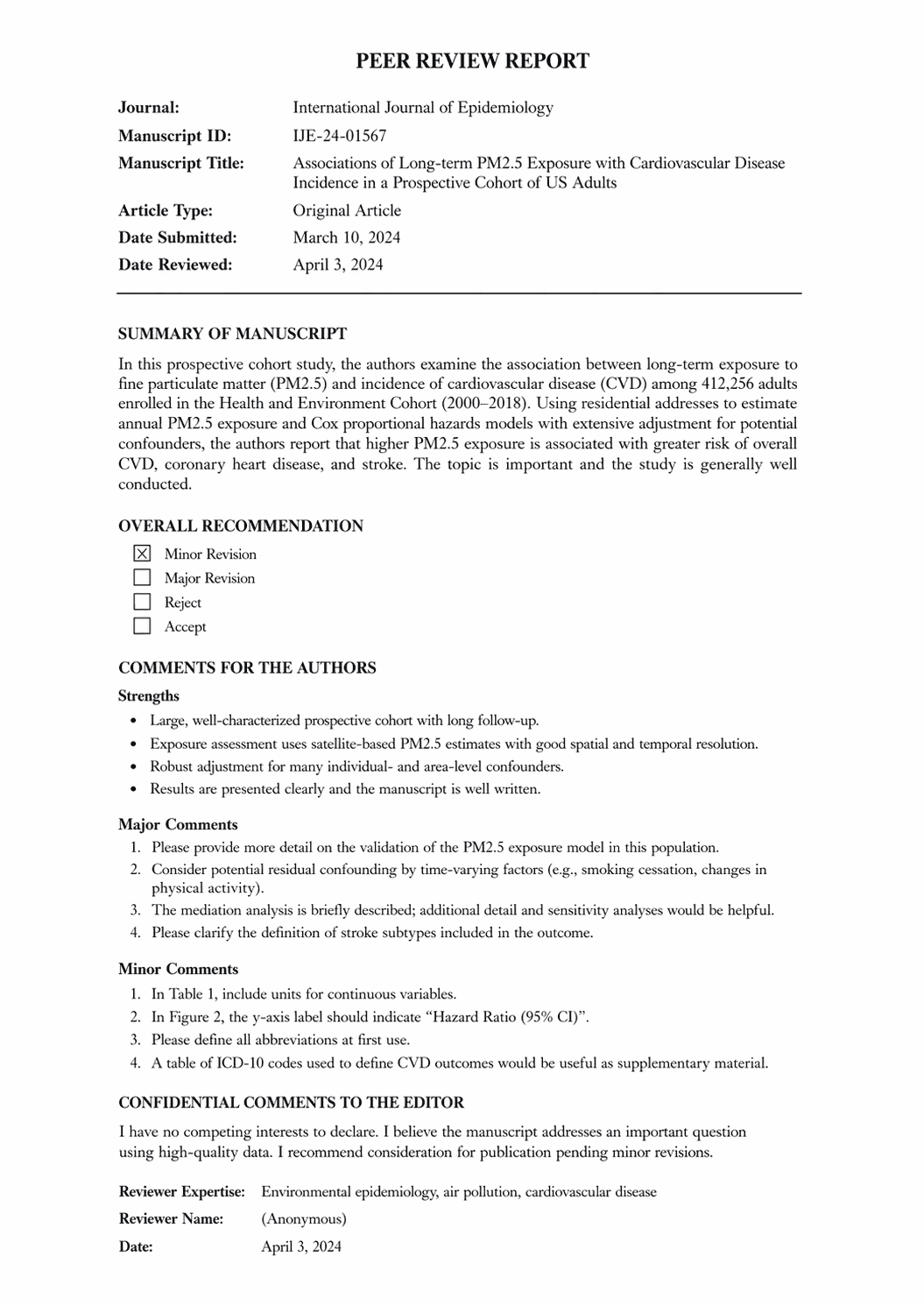
Open peer review involves making the peer review process publicly available either before or after publication of the article.
Example of open peer review
To understand how open peer review works, take a look at this example from BMJ Open;

What are the advantages of open peer review?:
- Greater transparency
- Better-quality reviews (less biased, more professional tone, more comprehensive feedback)
- Increased recognition for reviewers
- Increased trust from readers
What are the disadvantages of open peer review?
- Reviewers may hesitate to give critical feedback out of fear of retaliation
- Reviews may be less critical of articles by prominent or senior researchers
- Smaller reviewer pool if many reviewers hesitate to make their identities public
- Longer and more tedious peer review process (especially for post-publication reviews)
What is Post Publication Peer Review?
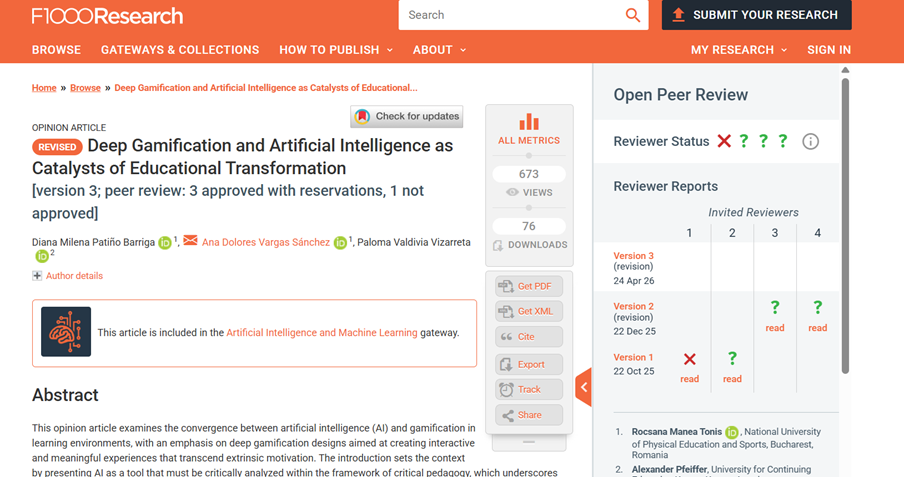
Post-publication peer review involves evaluation of a research paper even after it is published. The article may or may not have undergone pre-publication peer review.
Example of post-publication peer review
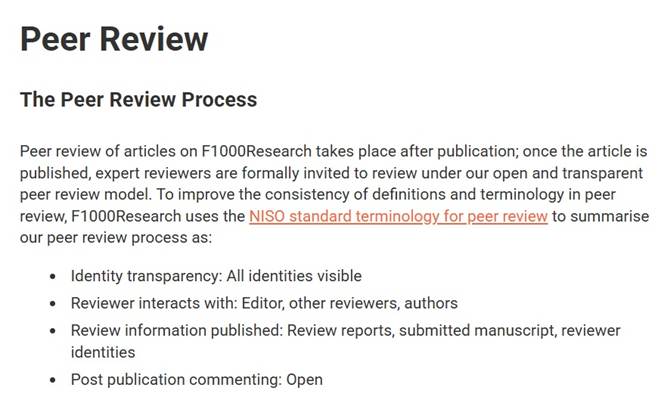
If you want to see what an article with open post publication peer review looks like to readers, here’s an example:
How to pass peer review
Passing peer review, though not easy, is possible for most researchers if they take care of the following:
- Select a research question that is currently important and relevant to your field
- Choose study design carefully, select appropriate methodology, and run rigorous analyses
- Describe your methodology thoroughly in the paper to facilitate replication
- Explicitly state in your cover letter and manuscript why your study is needed and what it contributes to existing knowledge
- Craft a compelling and descriptive title and abstract.
- Ensure your manuscript is written clearly and free of basic language errors
- Choose a journal whose aims and scope match your paper and that has published papers similar to yours
- Make sure your paper meets all formatting requirements from the journal and contains all necessary disclosures.
- Run a plagiarism check to catch any accidental plagiarism.
- Respond to peer review comments systematically and professionally and on time.
- Make it easy for reviewers to see what changes you have made in your paper.
- Seek presubmission peer review: before submitting a paper to a journal, get it vetted by an independent expert in your field to identify any major content flaws or technical gaps.
What is the difference between peer review and editorial review?
While peer review is an evaluation of a paper’s scientific quality and is done by external experts, editorial review is a preliminary assessment of whether the manuscript should be sent for peer review and is done by the journal’s staff. Editorial review focuses on basic match with the journal aims and scope, whether all disclosures and necessary content are included, whether the manuscript is formatted correctly, and often a scan for plagiarism and AI-generated text. Manuscripts that fail editorial review are usually returned to the author without peer review.
Frequently Asked Questions
How long does peer review take?
Peer review can take a few weeks to several months, depending on what kind of journal you are submitting to and how easy it is to find reviewers in your field.
Can I suggest peer reviewers?
Many journals ask authors to suggest peer reviewers, and you can do so unless the journal specifically asks you to not suggest peer reviewers. Usually, you can list suggested reviewers in your cover letter. Provide their institutional email addresses and ORCID to help the journal confirm the reviewers’ identity. Keep in mind that suggested peer reviewers should not be
- Based at the same institution as you or any of your co-authors
- Have collaborated with you or any of your co-authors (whether in the past or currently)
- Have any personal or financial ties related to your research
How do I handle conflicting peer review comments?
If you receive conflicting peer review comments, it’s important to analyze both perspectives and come up with a structured, evidence-backed response outlining which steps you have chosen to follow. You can also reach out to the journal editor if two reviewers are asking for completely opposite changes (e.g., Reviewer 1 asks you to describe your post-hoc analyses in more detail and Reviewer 2 asks you to remove them from the paper).
How do I handle inaccurate peer review comments?
If you believe that a peer reviewer has misunderstood your paper or is suggesting scientifically unsound changes, respond in a step-by-step and polite manner. Explain your reasoning with the help of citations from high-quality articles. Use neutral language such as “We believe that there may have been a misunderstanding regarding X”. Also, critically review your paper for any ambiguities that could lead others to also misunderstand your paper, and rewrite the text to make it clearer and more accurate wherever possible.
What can I do if I don’t agree with peer review comments?
If you find yourself instinctively opposing some or many peer review comments, you should
- Wait another 2-3 days to relook at the comments with a fresh pair of eyes
- Consult your co-authors on how to move forward
- Create a structured response document to outline your opinions
- Provide solid data or citations to justify your point of view
- Review your responses for a polite and professional tone
- Acknowledge your own errors or oversights, even if minor.
- Thank the journal editor and peer reviewers for their time and efforts.