

|
Getting your Trinity Audio player ready...
|
The easiest way to avoid desk rejection is to clearly highlight the novelty and significance of your study in your cover letter and abstract, to submit your article to a journal with matching aims and scope, and to make sure your manuscript follows all journal guidelines, including word count, disclosures required, and formatting. But this is easier said than done, so we’ll explore desk rejection and preventive measures in more detail in this article.
Jump to Contents
What are the main causes of desk rejection?
What to do after desk rejection
What is desk rejection?
Desk rejection occurs when your manuscript is rejected by your journal soon after submission, without undergoing peer review.
What are the main causes of desk rejection?
The most common reasons for desk rejection are as follows:
| Cause of Desk Rejection | Explanation | Example |
| Out of Scope | The manuscript does not match the journal’s aims, subject area, or readership. | A paper on the mechanisms of T cell exhaustion in neonates submitted to a practitioner-focused pediatrics journal. |
| Lack of Novelty | The study does not provide new findings or sufficient advancement over existing literature. | Another cross-sectional study confirming that smoking increases hypertension risk without adding new data or methods |
| Poor Study Design | The methodology is obviously weak, inappropriate, or insufficient to support the conclusions. | A case-control study without matching |
| Inadequate Sample Size | The number of participants is too small to provide reliable conclusions. | A study claiming that Vitamin K supplementation decreases the risk of measles, from a sample of 10 children |
| Ethical Concerns | Missing ethics approval, patient consent, or concerns about research integrity | A retrospective study using electronic health records without mentioning Institutional Review Board approval. |
| Poor Language and Presentation | Serious grammar, clarity, formatting, or structure issues make the paper difficult to assess. | A manuscript with unclear objectives, inconsistent terminology, and poorly labeled tables. |
| Incomplete Reporting | Key sections, data, or required reporting guidelines are missing. | A randomized controlled trial submitted without CONSORT flowchart or trial registration details. |
| Plagiarism or High Similarity | Significant text overlap with published work or self-plagiarism | Large parts of the methods and results sections duplicate another published article |
| Failure to Follow Journal Instructions | The manuscript ignores formatting, word count, or submission requirements. | Submitting a 5000-word manuscript to a journal that has a limit of 3000 words |
How to avoid desk rejection
The most important things you can do to avoid desk rejection are
Choose the right journal
Pick a journal whose aims and scope are in line with your study. Look for journals that have published papers similar to yours, and check the reference list of your own paper for journals that frequently appear. Do not choose a journal solely based on its impact factor or reputation.
Highlight novelty and significance
Your abstract, cover letter, and introduction section should make it clear to readers what new information or insights your study contributes, and what are the theoretical or practical implications of your findings.
Write clearly and correctly
Multiple typos, grammatical errors, and unclear sentences make it difficult for readers to understand what you’re saying. If English isn’t your first language, get your manuscript professionally edited by a native speaker who has expertise in your field.
Include all required information
Cross-check your article against standard reporting guidelines like CONSORT or STROBE to verify you have included sufficient details about your study. Also go through the journal guidelines to confirm what disclosures the journal requires from you and in what format.
Verify you have met all journal requirements
Pay attention to journal guidelines regarding word count, number of figures/tables, reference style, etc. Recheck where you need to disclose conflicts of interest, funding, IRB approval, etc.: some journals ask for this information in the cover letter, whereas others ask for it to be part of the main manuscript.
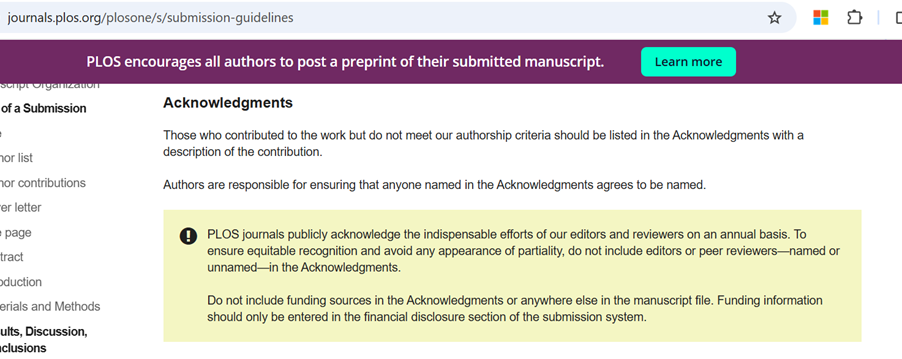
For example, PLOS ONE strictly prohibits disclosing funding in the manuscript file:
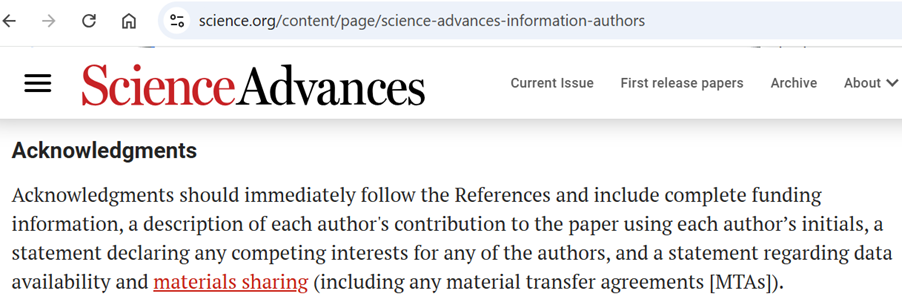
But Science Advances requires funding information to be given in the Acknowledgements section.
Run a plagiarism scan
It’s a good idea to run a plagiarism check prior to submission, to catch any areas where your paper substantially duplicates another published work. I would advise using iThenticate for this, as it’s the most popular plagiarism detector among journals.
What to do after desk rejection
If you’ve received a desk rejection, your next steps should be
- Avoid blaming yourself, colleagues, the journal, etc. Desk rejection is a part of academic life. It doesn’t spell the end of your research career.
- Analyze the feedback to understand whether the rejection was for scope mismatch, language quality, scientific quality, etc.
- Make any revisions to improve the manuscript on the basis of the feedback, e.g., by adding a clearer statement of why the study is novel or indicating why it is of benefit to practitioners.
- Resubmit to the target journal only if the desk rejection was for issues other than scope and fit (such as for missing funding information).
- Choose another journal if journal scope and fit was cited as the main reason for the previous desk rejection. For example, if your paper on periodontitis as a risk factor for cardiorenal mortality in diabetes patients was rejected from a dentistry journal, try resubmitting it to an endocrinology or diabetes-focused journal instead.
- Set aside enough time to reformat the paper. Do not immediately resubmit the paper without making sure it conforms to the new journal’s requirements.
Frequently Asked Questions
Can I resubmit a manuscript to the same journal after desk rejection?
Yes, you can resubmit the manuscript to the same journal after desk rejection if the main reason for desk rejection was something you can easily fix, like missing declarations. If the journal rejected your paper for scope mismatch or because of scientific quality, it’s unlikely to reconsider your paper again.
Can I appeal desk rejection?
You can appeal desk rejection in cases where the journal seems to have completely misunderstood your paper. These are very rare, however. Otherwise, appealing is unlikely to work and will probably just waste your time and delay your publication further.
How to respond to desk rejection?
Many journals don’t expect a formal response for desk rejection. If the journal has given you some specific and valuable feedback on how to improve the paper, you can send a polite and brief email thanking them.



Leave a Reply