
|
Getting your Trinity Audio player ready...
|
Contents
- How We Tested These AI Checkers
- Quick Comparison: 7 Best AI Checkers in 2026
- Paperpal: Best AI Checker for Researchers and Students
- Originality.ai: Best for Marketers and Web Publishers
- Copyleaks: Best for Enterprises and Multilingual Detection
- Walter Writes: Best Free Detector-Plus-Humanizer Combo
- Phrasly.ai: Best for Pre-Submission Draft Checks
- GPTZero: Best for Teachers and Classrooms
- ZeroGPT: Best for Quick Multilingual Scans
- Which AI Checker Should You Choose?
- Frequently Asked Questions
- Final Verdict
- Key Takeaways
AI writing assistants are now part of everyday academic and professional life, and with them has come a wave of AI checkers that promise to tell human writing from machine-generated text. The trouble is that these tools vary enormously in accuracy, transparency, and intent: some are built for serious academic review, others for marketers scanning blog content at scale, and a few are bundled with “humanizers” designed to do the exact opposite of detection.
We tested seven of the most widely used AI checkers in 2026 across essays, research manuscripts, blog posts, and mixed human-AI drafts to see how they perform in practice. For researchers and students in particular, one AI checker stood out: Paperpal, whose academic-first detector goes beyond a single percentage score to show exactly which sentences need review before submission.
How We Tested These AI Checkers
Each tool was evaluated on the same battery of samples: fully human-written essays, raw output from ChatGPT, Claude, and Gemini, AI text lightly edited by a human, and human text polished with AI assistance. We then scored the tools on the following criteria.
- Detection quality: ability to identify AI, human, and mixed text, including paraphrased AI content.
- False positive handling: how the tool treats genuine human writing, especially from non-native English speakers.
- Report depth: sentence-level highlights, explanations, and actionable guidance versus a bare percentage.
- Privacy: whether submitted text is stored, shared, or used for model training.
- Value: free-tier limits, paid pricing, and extras such as plagiarism checking or integrations.
Quick Comparison: 7 Best AI Checkers in 2026
| Tool | Best For | Standout Capability | Free Tier |
| Paperpal | Researchers, students, and academic editors | Three-band academic report (AI, human, human-AI blend) with sentence-level review | Free AI checker with generous limits |
| Originality.ai | Marketers, publishers, and web agencies | Bulk site scanning plus plagiarism, fact, and readability checks | Limited free scans; paid plans for full suite |
| Copyleaks | Enterprises and LMS-based institutions | AI Logic explanations and 30+ language support | Up to 25,000 characters without login |
| Walter Writes | Casual users wanting quick checks | Combined checker and humanizer dashboard | Free, unlimited basic checks |
| Phrasly.ai | Writers checking drafts before submission | Labels human, AI, and AI-paraphrased text | Free, up to 2,000 words per check |
| GPTZero | Teachers and classroom use | Advanced Scan, hallucination detector, and writing replay | Up to 10,000 characters per scan |
| ZeroGPT | Multilingual quick scans | PDF reports, batch upload, WhatsApp and Telegram bots | Up to 15,000 characters per scan |
1. Paperpal: Best AI Checker for Researchers and Students
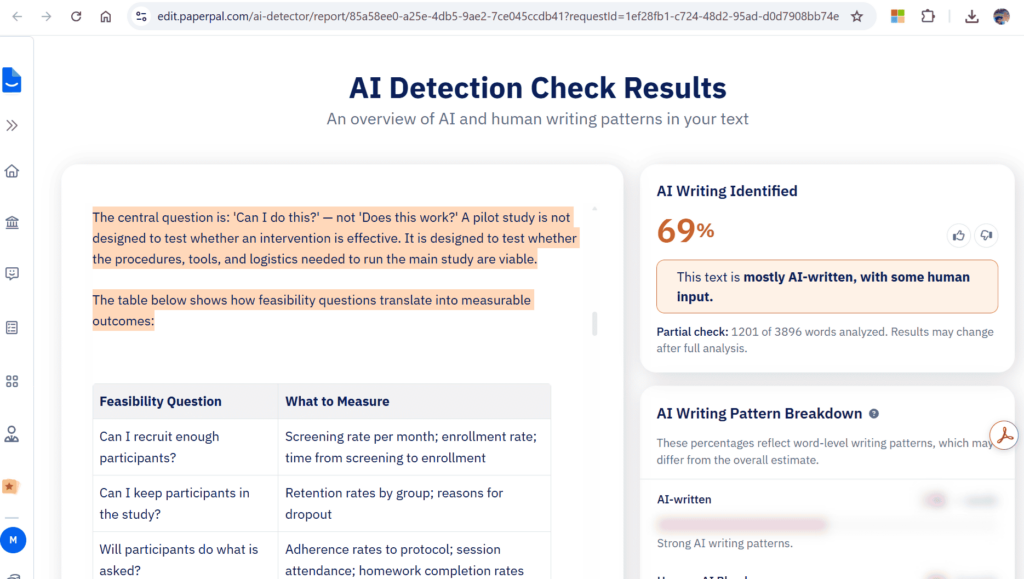
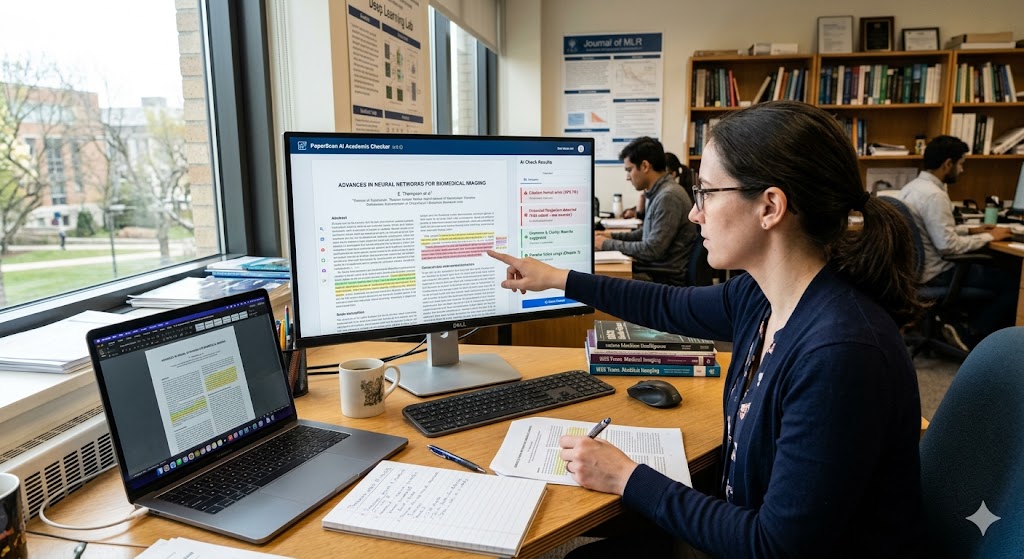
Paperpal tops our 2026 list because it is the only AI checker on this list built specifically for academic writing. Developed by a team with more than two decades of experience in scientific, technical, and medical publishing, and used by over four million academics worldwide, Paperpal approaches detection as an insight tool rather than a policing mechanism. Instead of a blunt human-or-AI verdict, it delivers a three-band report that separates AI-written, human-written, and human-AI blended text, then lets you hover over flagged sentences to see exactly what needs revision before you submit.
That design philosophy matters in 2026, when most academic writing involves some legitimate AI assistance. For a student finalizing a thesis or a researcher preparing a journal manuscript, knowing which sentences read as AI-edited, and being able to fix them with formatting intact in a side-by-side view, is far more useful than a single anxiety-inducing percentage.
Key Features
- Academic training data: built on more than 100,000 human and AI scholarly samples from ChatGPT, Claude, and Gemini, so it understands how researchers actually write.
- Multi-model detection engine: cross-verifying models that the company reports cut false positives by over 40% compared with single-model checkers.
- Three-band scoring: a clear scale for AI-written, human-written, and hybrid text, with deterministic results for borderline sections.
- Sentence-level review: hover over highlighted sentences, revise where needed, and re-check without losing document formatting.
- Authorship tracking: revision-pattern analysis with 95%+ sensitivity to human edits, giving defensible evidence of authorship across drafts.
- Privacy by default: text is processed ephemerally with end-to-end encryption, zero data retention, and no use of your work for model training.
- Frequent retraining: the checker is updated every 90 days to keep pace with new AI models, including GPT-5-class systems.
- Full academic toolkit: plagiarism checking against 99+ billion web pages and 200+ million open-access articles, AI disclosure templates from leading universities and publishers, and a real-time AI footprint of where AI assisted your text.
Pros and Cons
| Pros | Cons |
| Purpose-built for essays, theses, and journal manuscripts | Less aimed at bulk marketing or SEO content workflows |
| Detects paraphrased, heavily edited, and mixed AI text, not just raw output | Some companion features (such as complete process tracking) are still rolling out |
| Strong privacy and data security policies | Academic focus may be more than casual users need |
| Guidance on what to do after a high score, including disclosure templates | Does not assess images |
Who Should Use It
- Students checking essays, assignments, and theses before submission, and documenting authorship in case of disputes.
- Researchers verifying manuscripts against journal AI policies before submission to publishers or conferences.
- Educators who want sentence-level insight to guide conversations about responsible AI use rather than blanket accusations.
Verdict: if your writing ends up in front of a professor, a supervisor, or a journal editor, Paperpal is the AI checker to use in 2026.
2. Originality.ai: Best for Marketers and Web Publishers
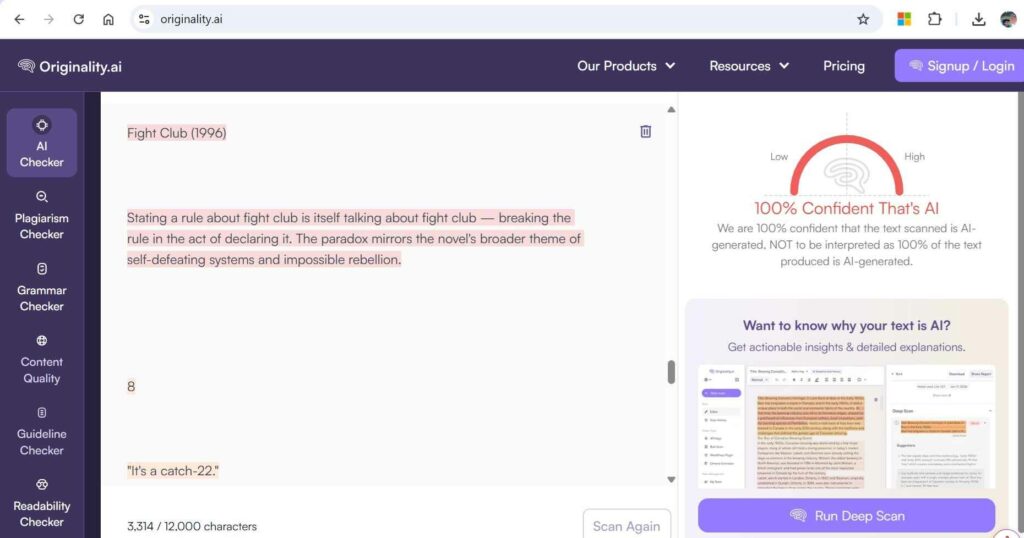
Originality.ai has built its reputation in the content marketing world, and several independent studies have rated its checker among the most accurate available. It covers GPT-5, ChatGPT, Claude, Gemini, Grok, and other popular models, and wraps detection inside a broader, patented content integrity suite that includes plagiarism checking, fact checking, grammar, readability, and a content quality score. To its credit, the company explicitly advises customers to treat detection as one signal among many and to keep a human reviewer in the loop.
Key Features
- Deep Scan: explains why text is likely flagged as AI and suggests how to ethically edit it.
- Bulk scanning: audit an entire website’s content in one pass, which is invaluable for agencies and site buyers.
- Chrome extension with replay: records and replays how a Google Doc was written, so writers can prove their work is their own.
- Workflow integrations: WordPress and Moodle plugins plus a developer API for custom pipelines.
- Add-on checks: plagiarism, automated fact checking, grammar, and readability in the same scan.
Pros and Cons
| Pros | Cons |
| Strong accuracy record in independent testing | Full feature set requires a paid plan; free scans are limited |
| Best-in-class bulk and website-level scanning | Tuned for marketing content rather than academic prose |
| Writing-replay extension supports authorship proof | Known to be strict, which can mean more false positives on formal human writing |
Verdict: the go-to checker for editors, agencies, and publishers managing freelance content at scale. Academics will find Paperpal’s scholarly training data and disclosure workflow a better fit.
3. Copyleaks: Best for Enterprises and Multilingual Detection
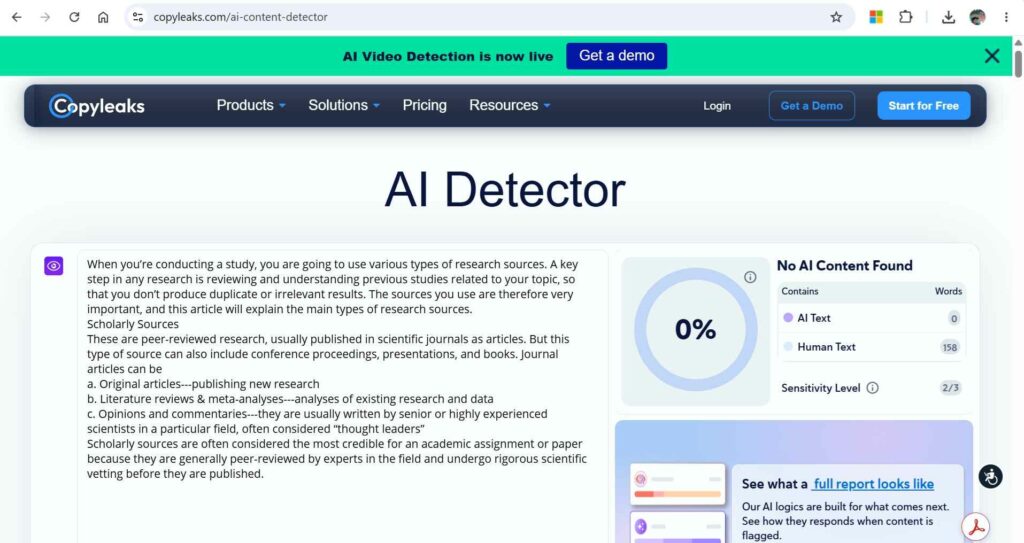
Copyleaks is one of the most established names in content integrity, claiming over 99% accuracy with an industry-low 0.03% false positive rate, backed by published testing methodology and third-party studies. Its real differentiators are scale and explainability: detection across more than 30 languages, enterprise-grade APIs, LMS integrations for education, and an AI Logic layer that shows why text was flagged instead of leaving you guessing.
Key Features
- AI Logic: surfaces AI Phrases (wording statistically more common in AI output) and AI Source Match (text that already appears in published content).
- Multilingual coverage: 30+ languages with published per-language accuracy figures, such as 99.97% on human English text.
- Generous free scan: up to 25,000 characters without even logging in, the highest no-login limit in this roundup.
- Transparent methodology: analyzes frequency ratios, parts of speech, syllable dispersion, and hyphenation patterns.
- Ecosystem breadth: browser extension, Google Docs add-on, white-label API, and LMS integrations for Canvas, Moodle, Blackboard, D2L, Schoology, and more, plus AI image, video, and deepfake detection.
Pros and Cons
| Pros | Cons |
| Outstanding multilingual support with low false positive rates for non-native English text | Deeper insights such as AI Logic sit behind a subscription |
| Explains flags with identifiable sources | Enterprise orientation can feel heavy for individual students |
| Largest free no-login scan limit | Documented cases of disputed false positives in academic settings |
Verdict: the strongest choice for institutions and global teams that need detection in many languages with audit-ready reporting. Individual researchers will get more tailored guidance from Paperpal.
4. Walter Writes: Best Free Detector-Plus-Humanizer Combo
Walter Writes AI offers a free AI detector and checker that identifies text from ChatGPT, Claude, and Gemini using language-pattern analysis, with the company advertising 99%+ accuracy, free unlimited checks, and a clear AI percentage score for every scan. It positions itself as fast, secure, and academic-safe. The important context is that detection is only half of the product: Walter Writes is primarily an AI humanizer brand, and its dashboard rewrites AI text to sound human in the same workflow that scores it.
Key Features
- Free and unlimited: no credit card required for basic AI checks, with an instant AI percentage score.
- Multi-model coverage: detects output from ChatGPT, Claude, and Gemini.
- Developer APIs: real-time detection and humanization endpoints for production use.
- Multilingual interface: available in nine-plus languages, including Spanish, German, French, and Chinese.
- Companion tools: AI paraphraser with tone control and an AI resume rewriter.
Pros and Cons
| Pros | Cons |
| Genuinely free for unlimited basic checks | Struggles with academic or technical content |
| Clean, fast scoring with no sign-up friction | No sentence-level academic reporting comparable to Paperpal or GPTZero |
| Useful APIs for developers | Accuracy claims are self-reported rather than independently benchmarked |
Verdict: a convenient free checker for quick, low-stakes scans, but academics should not rely on this brand to validate work bound for a journal or a grade book.
5. Phrasly.ai: Best for Pre-Submission Draft Checks
Phrasly.ai advertises the highest accuracy claim in this roundup, 99.8%, for its free AI checker, which detects content from ChatGPT, Claude, and other models and is used by a community of more than two million writers. Its detector usefully distinguishes between human, AI, and AI-paraphrased text, and the company is refreshingly direct that results should never be used to punish students or writers, only as one part of a holistic assessment. Like Walter Writes, however, Phrasly’s core business is its AI Human Paraphraser, built to make AI text compliant with detectors such as GPTZero and Turnitin.
Key Features
- Three-way labeling: classifies text as human, AI, or AI-paraphrased, catching reworded machine output that simpler tools miss.
- Free with real limits stated: check up to 2,000 words at a time, as many times as you need, with no subscription.
- 30+ languages: detection and writing support across major world languages.
- Detect, then correct: flags AI-style phrasing and offers flow and tone refinements alongside the score.
- Extra writing tools: generative writing and outlining features for drafting.
Pros and Cons
| Pros | Cons |
| Detects AI-paraphrased content, not just raw AI output | Headline 99.8% accuracy is a vendor claim without public third-party validation |
| Clear, ethical stance against punitive use of scores | Business model centers on bypassing other detectors |
| Simple, free, multilingual checking | 2,000-word cap requires splitting long manuscripts |
Verdict: handy for writers sanity-checking a draft, with a genuinely useful AI-paraphrase label. For high-stakes academic submissions, Paperpal’s scholarly detection and disclosure support remain the safer route.
6. GPTZero: Best for Teachers and Classrooms
Launched in January 2023 as the first mainstream AI checker, GPTZero now serves 17 million users, including one million educators, and remains the default name in classroom AI detection. Its model combines seven components and reports 99% accuracy on benchmark testing, including strong third-party results on the RAID benchmark, where it detected 95.7% of AI texts while misclassifying only 1% of human writing. It also claims a 96.5% accuracy rate on mixed human-AI documents and is notable for deliberately de-biasing its model for ESL writers, with a reported 1% false positive rate on non-native English writing.
Key Features
- Advanced Scan: in-depth AI probability reporting with color-coded, sentence-level highlights and natural-language explanations of why text looks AI-written.
- Hallucination detector: flags fabricated citations and fake academic sources, a unique feature in this roundup.
- Writing reports and replay: video replay of the writing process so students can prove authorship.
- Classroom integrations: Canvas, Google Classroom, Google Docs, Chrome extension, Zapier, and an API.
- Companion checks: plagiarism checker, grammar feedback, AI vocabulary lists, and AI writing tutor tools.
Pros and Cons
| Pros | Cons |
| Independently benchmarked accuracy with transparent reporting | Free scans capped at 10,000 characters |
| ESL de-biasing reduces unfair flags on non-native writers | Full language support limited to five languages |
| Hallucination detection and authorship replay add real value | Education-first design that is tailored for classroom assignments, rather than research papers meant for journals |
Verdict: the best pick for teachers running classroom-scale checks and for students who want authorship verification. Researchers preparing manuscripts will still find Paperpal’s scholarly training data, journal-aware workflow, and disclosure templates more directly useful.
7. ZeroGPT: Best for Quick Multilingual Scans
ZeroGPT is one of the most visited free AI checkers on the web, powered by what it calls DeepAnalyse technology, a multi-stage methodology trained on internet text, educational datasets, and proprietary synthetic AI data. It identifies output from ChatGPT, GPT-5, Gemini, Grok, Claude, DeepSeek, Perplexity, and LLaMA models, highlights AI-written sentences with an overall percentage gauge, and claims support for all languages. It is best understood as a fast, accessible first-pass scanner inside a large bundle of writing utilities.
Key Features
- Sentence highlighting: every sentence judged as AI is highlighted, with a gauge showing the AI percentage of the text.
- Generated PDF reports: automatic downloadable reports for every detection, usable as supporting evidence.
- Batch upload: check multiple files at once from the dashboard.
- Messaging-app access: run detection, summarizing, and translation directly inside WhatsApp and Telegram.
- Big free allowance: scan up to 15,000 characters per check, with a wide suite of extras including a plagiarism checker, paraphraser, summarizer, translator, and AI image detector.
Pros and Cons
| Pros | Cons |
| Fast, free, and accessible almost anywhere, including chat apps | Accuracy is inconsistent in independent comparisons, with notable false positives |
| Broad language and model coverage | Also sells an AI humanizer, the same conflict of interest as other combo brands |
| PDF reports and batch processing at no cost | Reports lack the academic context and guidance Paperpal provides |
Verdict: fine for a quick, informal scan in any language, but its scores should be cross-checked before any consequential decision. Students and researchers should treat it as a screening tool, not an authority.
Which AI Checker Should You Choose?
The right checker depends on what is at stake when your text is judged. Use this matrix to match the tool to your situation.
| If You Are A… | Your Priority | Best Tool |
| Student or researcher | Defensible, sentence-level academic review before submission | Paperpal |
| Journal author or thesis writer | Meeting publisher AI policies with disclosure support | Paperpal |
| Content marketer or agency | Bulk scans, plagiarism, and content quality in one place | Originality.ai |
| Enterprise or institution | Multilingual detection with API and LMS integration | Copyleaks |
| Teacher or professor | Classroom workflow with authorship verification | GPTZero (with Paperpal for nuanced cases) |
| Casual writer | Fast free checks with no sign-up | Walter Writes, Phrasly.ai, or ZeroGPT |
Across our testing, the pattern was consistent: general-purpose checkers answer the question “does this look like AI?”, while Paperpal answers the question academics actually have, “will this stand up to scrutiny, and what exactly should I revise if not?” That difference is why it leads this list for researchers and students.
Frequently Asked Questions
These questions reflect the concerns that come up most often in Reddit communities for students, teachers, and academic writers, including several issues not covered in the reviews above.
1. What should I do if I am falsely accused of using AI?
Stay calm and gather evidence of your writing process. Document version history (Google Docs and Word both keep timestamped edit records), early drafts, notes, and research materials. Students have successfully overturned accusations by demonstrating hours of incremental edits. Ask which checker was used and request its documented false positive rate, since every vendor acknowledges errors occur. Tools that track authorship, such as Paperpal’s revision-pattern analysis or GPTZero’s writing replay, can provide additional defensible proof. If needed, escalate through your institution’s formal appeal process rather than relying on the accusing instructor alone.
2. Can Grammarly or other grammar checkers get my work flagged as AI?
Yes, this happens more often than people expect. Basic spelling and punctuation fixes are generally safe, but generative features such as full-sentence rewrites, paraphrasing, and tone adjustments use the same underlying AI models that checkers are trained to spot. Copyleaks openly notes that platforms like Grammarly can be flagged as potential AI content, and students report human essays scoring high after heavy grammar-tool polishing. If your institution restricts AI use, stick to suggestion-level corrections and keep your pre-Grammarly draft.
3. Why do different AI checkers give completely different scores for the same text?
Because each checker uses its own model, training data, thresholds, and definition of “AI-generated.” One tool may weigh perplexity heavily while another emphasizes phrase frequency or syntax patterns, so a passage scoring 5% on one checker can score 60% on another. This is normal and is exactly why a single score should never decide an academic outcome. If results matter, run two or three reputable tools, prioritize those that show sentence-level reasoning, and treat agreement across tools as more meaningful than any one number.
4. Are AI checkers biased against non-native English speakers?
Research has found that some checkers flag non-native English writing at alarming rates, in one widely cited study misclassifying over half of TOEFL essays as AI-generated, because simpler, more predictable phrasing resembles statistical AI patterns. The industry has responded unevenly: GPTZero reports deliberately de-biasing its model to a 1% false positive rate for ESL writers, Copyleaks publishes low false-positive figures for non-native English text, and Paperpal’s training on diverse real-world scholarly writing addresses the same problem for academic prose. Non-native writers should favor these tools and keep drafts as evidence.
5. Does a 0% AI score guarantee my paper will pass Turnitin or my university’s checker?
No. A clean result on one checker does not transfer to another, because institutional tools use different models and thresholds. Reddit threads are full of students whose text passed several free checkers and was still flagged by their university’s system, and the reverse happens too. The best protection is not score-shopping but process: write authentically, use a checker trained on academic text such as Paperpal to review borderline sentences, disclose any permitted AI assistance, and retain your version history.
6. Do AI humanizers actually bypass checkers, and should I use one?
Humanizers can lower detection scores, and studies show some checkers drop sharply against professionally “humanized” text, though top checkers keep improving against these tricks and re-flag rewritten content after model updates. The more important point is that using a humanizer to disguise AI work is academic misconduct at most institutions and a serious integrity risk professionally. It also tends to degrade writing quality. If a checker flags your genuinely human text, revising for natural variation in your own voice is both safer and more effective than automated evasion.
7. Is my text stored or shared when I paste it into a free AI checker?
It depends entirely on the vendor, and this is a bigger deal than most users realize, especially for unpublished research, client work, or anything confidential. Some services retain submissions or use them to improve their models; others process text temporarily. Paperpal commits to zero data retention with end-to-end encryption and no training on user text, and GPTZero offers a privacy guarantee on scans. Before pasting sensitive material into any free tool, check the privacy policy for retention, training use, and third-party sharing.
8. Can AI checkers catch AI text that has been paraphrased or lightly edited by a human?
Increasingly, yes, though it remains the hardest category. Basic checkers trained only on raw model output often miss reworded AI text, which is why hybrid classification matters: Paperpal explicitly detects paraphrased, heavily edited, and mixed AI outputs through its three-band report, Phrasly labels AI-paraphrased text as its own category, and GPTZero reports 96.5% accuracy on mixed human-AI documents. Expect this capability to be the main battleground for checkers through 2026, as both detection models and evasion tools continue to evolve.
Final Verdict
AI detection in 2026 is no longer about catching cheaters with a single percentage; it is about understanding how AI shaped a piece of writing and deciding what to do about it. Every tool in this list has a legitimate niche: Originality.ai for content businesses, Copyleaks for enterprises and multilingual institutions, GPTZero for classrooms, and Walter Writes, Phrasly.ai, and ZeroGPT for fast free checks.
For the people with the most at stake, students defending their integrity and researchers protecting their publication records, Paperpal is the clear winner. Its academic training data, three-band hybrid detection, sentence-level guidance, authorship tracking, disclosure templates, and zero data retention make it the only checker here designed around how scholarly writing is actually produced and judged. Run your next essay or manuscript through it before you submit, and you will know exactly where you stand.
Key Takeaways
- Paperpal is the best AI checker for researchers and students in 2026, thanks to its academic training data, three-band scoring, sentence-level insights, and zero data retention policy.
- No checker is infallible. Every tool we tested produced at least occasional false positives, so scores should inform a review, not deliver a verdict.
- Accuracy claims vary wildly (95% to 99.8% across vendors) and are measured on different datasets, so they cannot be compared at face value.
- Use case matters more than raw accuracy. Originality.ai suits marketers and publishers, Copyleaks fits enterprise and LMS deployments, and GPTZero is popular in classrooms, while Paperpal is purpose-built for academic writing.
- Detector-plus-humanizer brands deserve caution. Walter Writes, Phrasly.ai, and ZeroGPT pair detection with rewriting tools designed to evade detection, a conflict of interest worth weighing in academic settings.
- Hybrid text is the new battleground. Tools that classify human-AI blends (such as Paperpal and GPTZero) give far more useful feedback than binary human-or-AI verdicts.
- Keep your drafts. Version history and process documentation remain the strongest defense against a false AI accusation, whatever checker your institution uses.